

Buying a home has traditionally been considered one of the biggest financial milestones in India. But in 2026, the decision is no longer as simple as “rent is wasted money, so buying is better.” Property prices, home-loan interest, rising rents, job mobility and the opportunity cost of a large down payment have made the rent vs buy home India 2026 decision far more dependent on your individual numbers.
Suppose a home costs ₹1 crore but a comparable property can be rented for ₹30,000 per month. Buying may require roughly ₹20 lakh or more upfront depending on financing and transaction costs, followed by a substantial EMI, maintenance and other ownership expenses. Renting requires much less capital upfront—but the renter builds no ownership in the property. The financial outcome can change dramatically if the renter invests the down payment and the monthly difference instead. Current 2026 rent-vs-buy analyses increasingly account for this opportunity cost rather than comparing only rent with EMI.
That is why simply comparing:
₹30,000 Rent vs ₹70,000 EMI
doesn’t tell you which option is actually better.
A proper comparison needs to consider property price, rent, down payment, home-loan interest, loan tenure, stamp duty and registration costs, maintenance, rent escalation, property appreciation, investment returns and how many years you expect to live in the home. Current 2026 guidance similarly emphasizes that there is no universal winner; financial readiness, mobility and expected holding period materially affect the decision.
In this CredEstate guide, we’ll compare renting and buying using actual financial scenarios—including ₹50 lakh, ₹1 crore and ₹2 crore homes—and examine what happens over 5, 10, 15 and 20 years. We’ll also explain price-to-rent ratio, opportunity cost, break-even period and the lifestyle factors that financial calculators cannot measure.
By the end, you should be able to answer a much better question than simply “Is renting or buying better?”
For my income, city, property price, current rent and expected holding period—which option makes more sense?
Rent vs Buy Home India 2026: Quick Answer
For most people, the answer depends on three numbers: the price of the home, the rent of a comparable home, and how long you expect to stay there.
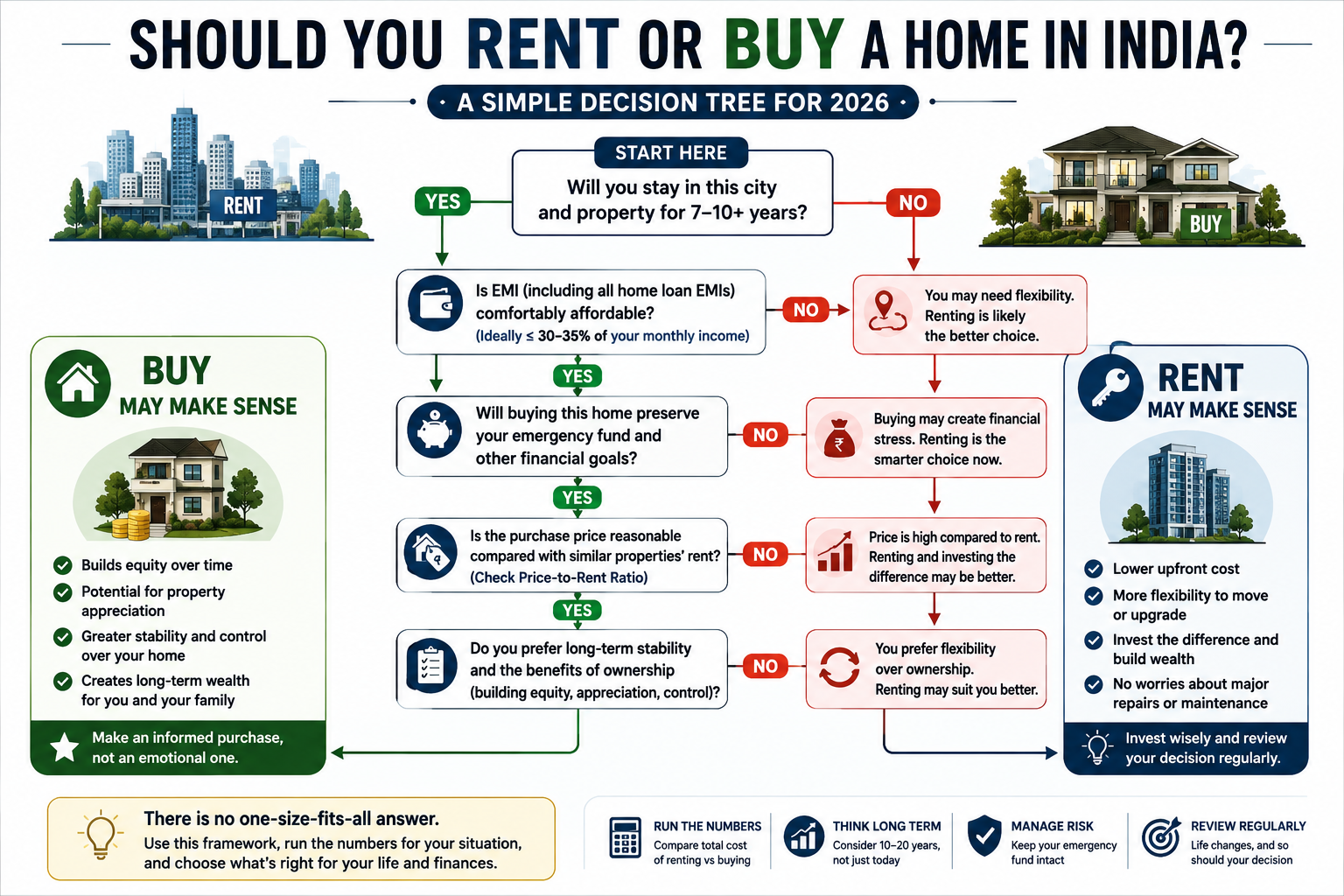
Buying can make more sense when you intend to live in the property for a long period, the purchase price is reasonable compared with rent, your EMI is comfortably affordable, and buying does not exhaust your emergency savings.
Renting can make more sense when a similar home is available at a relatively low rent compared with its purchase price, your career may require relocation, or buying would require a very large EMI and down payment. Renting becomes financially more powerful when the money that would otherwise go towards the down payment and higher monthly housing costs is actually invested rather than spent.
Rent vs Buy: Quick Comparison
| Factor | Renting May Be Better When | Buying May Be Better When |
|---|---|---|
| How long you’ll stay | 2–5 years or uncertain | 7–10+ years |
| Career/location | Relocation is likely | Location is stable |
| Property price vs rent | Purchase price is very high relative to rent | Purchase price is reasonable relative to rent |
| Upfront capital | You want to preserve liquidity | Down payment won’t drain savings |
| Monthly cash flow | EMI would stretch your finances | EMI is comfortably affordable |
| Flexibility | Very important | Less important |
| Customization | Not important | You want control over your home |
| Investment behaviour | You will invest the savings | You prefer building wealth through property |
| Family plans | Requirements may change soon | Long-term housing needs are clear |
| Ownership | Not currently a priority | Owning a home is an important goal |
A Simple ₹1 Crore Example
Suppose you are considering a home worth ₹1 crore, while a comparable property in the same locality can be rented for ₹30,000 per month.
Annual rent:
₹30,000 × 12 = ₹3,60,000
Now divide the purchase price by annual rent:
₹1,00,00,000 ÷ ₹3,60,000 = 27.8
The purchase price is therefore approximately 27.8 times the property’s current annual rent.
This is known as the price-to-rent ratio.
A high ratio tells you that buying is expensive relative to renting. But it does not automatically mean you should rent, because the calculation still ignores future rent increases, property appreciation, home-loan costs, investment returns and how long you will own the property.
CredEstate Quick Rule: Don’t decide whether to rent or buy from EMI alone. Start with the property’s price-to-rent relationship, then calculate the complete long-term cost of both options.
EMI vs Rent Is the Wrong Comparison
A monthly rent of ₹30,000 and a home-loan EMI of around ₹67,000 may make renting look obviously cheaper. But that comparison is incomplete because an EMI is not purely an expense: part of every EMI repays principal and gradually builds ownership in the property.
At the same time, buying also requires a large upfront investment. If a ₹1 crore home is purchased with an illustrative ₹80 lakh loan, the buyer may need roughly ₹20 lakh toward the purchase price before considering registration-related charges and other costs. RBI’s housing-finance framework also limits loan-to-value ratios rather than assuming the entire purchase price will always be financed.
For our comparison, we’ll use an illustrative 8% home-loan rate for 20 years. This isn’t a prediction of what every borrower will receive; actual rates depend on lender and borrower profile. As a current reference point, SBI advertises home loans starting from 7.25% p.a. from April 2026, subject to conditions.
₹1 Crore Home: Illustrative Buying Scenario
| Item | Assumption |
|---|---|
| Property Price | ₹1,00,00,000 |
| Down Payment | ₹20,00,000 |
| Home Loan | ₹80,00,000 |
| Interest Rate | 8% p.a. |
| Loan Tenure | 20 years |
| Approx. EMI | ₹66,915/month |
| Total EMI Payments over 20 years | ₹1.61 crore |
| Approx. Interest Paid | ₹80.6 lakh |
The EMI calculation shows something important:
₹66,915 EMI does not mean the house is costing ₹66,915 per month in the same way that ₹30,000 rent costs ₹30,000.
Part of the EMI goes toward repaying the ₹80 lakh principal, while the remainder represents interest.
But buying has other costs that the EMI doesn’t show:
- Down payment
- Stamp duty and registration
- Loan-related charges
- Maintenance
- Repairs
- Property tax where applicable
- Opportunity cost of the upfront capital
Likewise, renting has more to it than simply paying ₹30,000 every month.
The Renter Has an Investment Opportunity
Suppose the buyer puts ₹20 lakh into the property as down payment. The renter does not need to put that ₹20 lakh into the house. If the renter invests that capital instead, it can potentially compound over time.
There is also a monthly difference:
Buyer EMI: ₹66,915
Current Rent: ₹30,000
Difference:
₹36,915/month
If the renter actually invests some or all of that difference instead of spending it, the rent-vs-buy result can change dramatically.
This is the opportunity cost of buying.
But There’s an Important Catch
Many rent-vs-buy comparisons assume:
“The renter invests every rupee saved for 20 years.”
In real life, not everyone has that discipline.
If someone rents for ₹30,000 but spends the remaining ₹36,915 every month, the financial outcome will be very different from someone who systematically invests it. Similarly, many pro-buying calculations assume unrealistically high property appreciation every year.
Therefore, CredEstate’s comparison should not make either side win by manipulating the assumptions. CredEstate Principle: Compare the buyer’s property equity against the renter’s investment corpus using the same time period and clearly disclosed assumptions.
What a Fair Rent vs Buy Calculation Must Include
| Buying Side | Renting Side |
|---|---|
| Down payment | Security deposit |
| Stamp duty / registration | Initial rent |
| Home-loan EMI | Annual rent |
| Principal repayment | Rent escalation |
| Loan interest | Investment of initial capital |
| Maintenance | Investment of monthly savings |
| Repairs | Investment returns |
| Property appreciation | Moving costs |
| Property value at exit | Final investment corpus |
| Outstanding loan | — |
Then add:
This is why the simple question “Rent is ₹30,000 and EMI is ₹67,000 — which is cheaper?” cannot answer whether renting or buying creates more wealth over 10 or 20 years.
₹1 Crore Home vs ₹30,000 Rent: 5, 10, 15 and 20-Year Comparison
Let’s compare a ₹1 crore home with a similar property available for ₹30,000 monthly rent.
The purpose of this example is not to prove that renting or buying always wins. It is to demonstrate how the answer changes when we account for financing, appreciation, rent increases and opportunity cost.
Assumptions Used in This Calculation
| Assumption | Value |
|---|---|
| Property Price | ₹1 crore |
| Starting Monthly Rent | ₹30,000 |
| Home Loan | ₹80 lakh |
| Down Payment | ₹20 lakh |
| Home Loan Rate | 8% p.a. |
| Loan Tenure | 20 years |
| Approx. EMI | ₹66,915/month |
| Property Appreciation | 6% p.a. |
| Annual Rent Increase | 5% |
| Renter’s Investment Return | 10% p.a. |
| Holding Periods | 5, 10, 15 & 20 years |
Important: These are modelling assumptions, not guaranteed future returns. Property appreciation, investment returns, rent growth and home-loan rates can be higher or lower. Actual results will also vary based on taxes, maintenance, transaction costs and the specific property.
That disclaimer is essential.
What Happens to the ₹1 Crore Property?
If the property appreciates at an assumed 6% annually, its theoretical value becomes approximately:
| Holding Period | Estimated Property Value |
|---|---|
| Today | ₹1.00 crore |
| After 5 Years | ₹1.34 crore |
| After 10 Years | ₹1.79 crore |
| After 15 Years | ₹2.40 crore |
| After 20 Years | ₹3.21 crore |
But this is not the buyer’s equity yet, because during most of this period the home loan is still outstanding.
Buyer Equity Over Time
With an ₹80 lakh loan at an illustrative 8% for 20 years:
| Year | Estimated Property Value | Approx. Loan Outstanding | Approx. Property Equity |
|---|---|---|---|
| 5 | ₹1.34 Cr | ₹70.0 L | ₹63.8 L |
| 10 | ₹1.79 Cr | ₹55.2 L | ₹1.24 Cr |
| 15 | ₹2.40 Cr | ₹33.0 L | ₹2.07 Cr |
| 20 | ₹3.21 Cr | ₹0 | ₹3.21 Cr |
This table reveals something many simplistic rent vs EMI comparisons miss.
Even though the buyer pays approximately ₹66,915 every month, the loan balance gradually declines while the buyer’s ownership in the property increases.
However, this still doesn’t prove buying wins.
Why?
Because we haven’t yet calculated what happens to the renter’s money.
What Happens to ₹30,000 Rent Over Time?
If rent starts at ₹30,000 per month and increases by an assumed 5% each year, approximate monthly rent would become:
| Time | Approx. Monthly Rent |
|---|---|
| Year 1 | ₹30,000 |
| Year 5 | ₹36,500 |
| Year 10 | ₹46,500 |
| Year 15 | ₹59,400 |
| Year 20 | ₹75,800 |
This is why saying:
“My rent is ₹30,000 but EMI is ₹67,000.”
can also be misleading over a 20-year horizon.
The EMI on a conventional fixed-assumption calculation may remain around the same amount, while rent can increase over time.
Actual floating-rate home loans can of course experience rate/tenure changes, so real-world EMI behaviour can differ.
Now Comes the Most Important Part: Opportunity Cost
The renter initially avoids putting approximately ₹20 lakh into the property’s down payment.
If ₹20 lakh instead compounds at an assumed 10% annual return, without even adding monthly investments, it would theoretically grow to approximately:
| Investment Period | ₹20 Lakh Becomes |
|---|---|
| 5 Years | ₹32.2 L |
| 10 Years | ₹51.9 L |
| 15 Years | ₹83.5 L |
| 20 Years | ₹1.35 Cr |
And that’s before investing the difference between rent and the buyer’s housing expenses.
This is why opportunity cost is such an important component of a proper rent-vs-buy calculation. Current Indian comparison tools similarly model the investment potential of capital that would otherwise be committed to a home purchase.
But don’t make this common mistake
We shouldn’t write:
₹20 lakh becomes ₹1.35 crore, therefore renting wins.
That’s mathematically incomplete.
The buyer gets:
Property appreciation + principal repayment + eventual debt-free ownership
while the renter potentially gets:
Invested down payment + invested monthly savings + continued rental liability
Both sides need to be compared at the same future date.
One Important Correction to Our ₹1 Crore Example
We earlier used ₹80 lakh home loan + ₹20 lakh down payment for simplicity.
For a ₹1 crore property, however, current RBI prudential norms indicate that housing loans above ₹75 lakh generally carry an LTV ceiling of 75% in the relevant framework. Stamp duty, registration and documentation charges are also generally excluded from the financed property cost for LTV purposes.
Therefore, a more regulation-aligned illustration for a ₹1 crore property would be approximately:
Property: ₹1 crore
Maximum illustrative 75% financing: ₹75 lakh
Buyer contribution toward price: ₹25 lakh
+ applicable transaction costs
This is important for CredEstate’s credibility.
I recommend changing the previous ₹80 lakh loan / ₹20 lakh down-payment example to ₹75 lakh loan / ₹25 lakh buyer contribution throughout the article before publication.
Don’t leave contradictory numbers in different sections.
What Does This Comparison Tell Us So Far?
It tells us three things:
Buying builds equity.
Part of the EMI gradually converts debt into ownership.
Renting preserves capital.
The renter can potentially invest money that would otherwise have gone into the property.
Time changes the equation.
A decision that looks financially attractive over 3–5 years may look completely different over 15–20 years.
CredEstate Takeaway: Rent vs buy is ultimately a comparison between two future balance sheets—not simply today’s rent and today’s EMI.
Rent vs Buy Break-Even Point: After How Many Years Does Buying Make Sense?The break-even point is the point at which the financial outcome of buying becomes comparable to the alternative of renting and investing the money saved.
There is no fixed break-even period for every home in India. It depends heavily on:
- Property purchase price
- Rent for a genuinely comparable property
- Home-loan interest rate
- Down payment
- Property appreciation
- Annual rent increase
- Maintenance and ownership costs
- Registration and transaction costs
- Return earned on alternative investments
- How long you remain in the property
That is why statements such as “always buy if you will stay for 10 years” should be treated only as rules of thumb, not financial laws.
Why Holding Period Matters So Much
Buying involves substantial costs at the beginning of the transaction.
A buyer may have to commit money toward:
Down payment + stamp duty + registration + loan-related costs + initial repairs/interiors
If the property is sold only a few years later, there may not have been enough time for property appreciation and principal repayment to compensate for those costs and the opportunity cost of the capital invested.
Renting generally requires much less upfront capital, making it more flexible for shorter holding periods.
As the holding period becomes longer, however, several things begin changing simultaneously:
Buyer: loan balance declines and property equity can increase.
Renter: rent can increase, but invested capital also has more time to compound.
So time benefits both sides, not only the homeowner.
Our ₹1 Crore Example: What Changes With Time?
For our model, remember that we’re using illustrative assumptions rather than predictions:
Variable Assumption Property Price ₹1 crore Starting Rent ₹30,000/month Loan ₹75 lakh Buyer Contribution Toward Price ₹25 lakh Loan Interest 8% Loan Tenure 20 years Property Appreciation 6% p.a. Rent Increase 5% p.a. Alternative Investment Return 10% p.a. For housing loans above ₹75 lakh, RBI’s current prudential framework shows a maximum LTV of 75% for the relevant SCB/HFC category, which is why using ₹75 lakh financing on a ₹1 crore illustrative property is more appropriate than our earlier ₹80 lakh example.
Important: Fix the Previous EMI
Because we’ve corrected the loan from ₹80 lakh to ₹75 lakh, the previous EMI also needs to change.
At an illustrative 8% for 20 years:
Loan: ₹75,00,000
Approx. EMI: ₹62,730/monthSo replace every previous:
₹66,915 EMI
with:
₹62,730 EMI
And replace:
₹20 lakh down payment
with:
₹25 lakh buyer contribution toward property price
wherever we’re referring to this ₹1 crore scenario.
This consistency matters much more than getting another 2 points in Rank Math.
Why a 5-Year Buyer Faces a Different Equation From a 20-Year Buyer
If You Expect to Stay Around 3–5 Years
Renting deserves serious consideration when:
- Your career may require relocation
- The property has a high price-to-rent ratio
- Buying would consume most of your liquid savings
- Comparable rent is substantially below ownership cash flow
- You are uncertain about your future family requirements
A short holding period gives the buyer less time to spread the impact of transaction costs and benefit from long-term property appreciation.
If You Expect to Stay Around 5–10 Years
The decision becomes much more property-specific.
At this stage, compare:
Expected property equity at exit
against:
Renter’s investment corpus + difference in cumulative housing costs
This is where property price relative to rent becomes particularly important.
If You Expect to Stay 10–15 Years
Buying may become increasingly attractive in some scenarios because the loan principal has reduced materially and property appreciation has had more time to compound.
But renting can still outperform if the property was purchased at a very high price relative to rent and the renter consistently invests the capital difference.
If You Expect to Stay 15–20+ Years
The buyer approaches or reaches complete loan repayment in our 20-year model.
At the end of the loan, the homeowner potentially owns a debt-free property.
But the renter may simultaneously have accumulated a substantial investment portfolio.
Therefore, the final comparison remains:
Debt-free property value vs renter’s accumulated investment wealth and future housing requirement.
Don’t Use Someone Else’s Break-Even Year
This is an important section to include because competitors currently give substantially different answers.
One current India-focused 2026 analysis estimates that its particular ₹1 crore example reaches break-even at approximately 12–14 years.
Another 2026 city-based calculator estimates much longer periods for several expensive metropolitan markets, including around 22 years for its Delhi NCR assumptions.
Meanwhile, another recent Indian metro analysis suggests roughly 7–9 years under its own assumptions.
These aren’t necessarily contradictions.
They demonstrate that changing property price, rent, appreciation, investment returns, maintenance or transaction costs can radically change the answer.
CredEstate Break-Even Rule: Never ask, “After how many years is buying better?” without also asking, “At what property price, rent, interest rate, appreciation rate and alternative investment return?”
The Most Important Variable: Price Relative to Rent
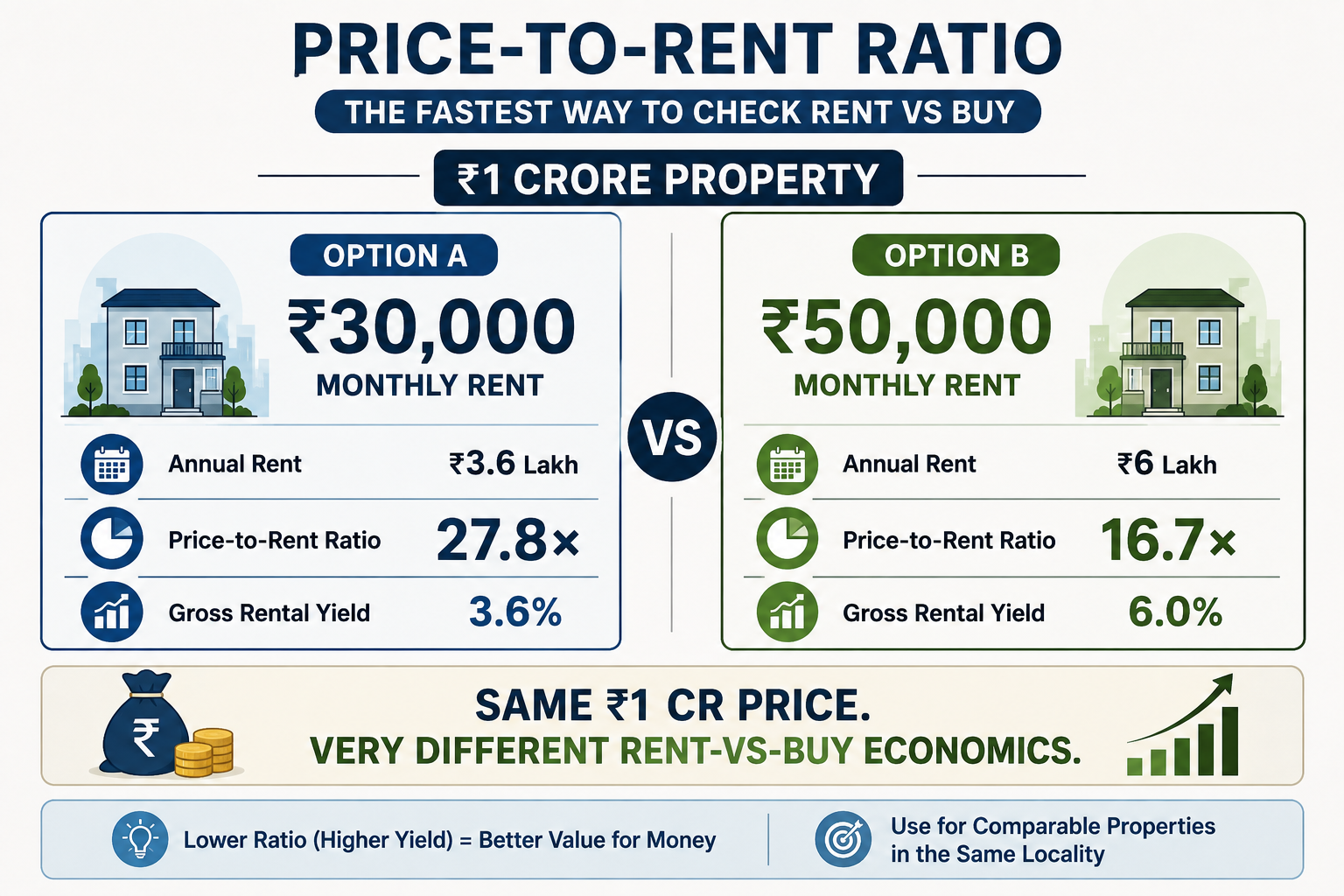
Consider two ₹1 crore properties.
Property A
Purchase price: ₹1 crore
Comparable rent: ₹30,000/month
Annual rent: ₹3.6 lakh
Price-to-rent ratio: 27.8Property B
Purchase price: ₹1 crore
Comparable rent: ₹50,000/month
Annual rent: ₹6 lakh
Price-to-rent ratio: 16.7Both properties cost exactly ₹1 crore.
But financially, they present very different rent-vs-buy equations.
This is why you should compare the purchase price against the rent of the same or genuinely comparable property, not against the average rent of an entire city.
CredEstate Takeaway
The longer you stay, the more time buying has to build equity—but the more time the renter’s investments also have to compound. Break-even is determined by the numbers, not simply the number of years.
Price-to-Rent Ratio: The Fastest Way to Check Rent vs Buy
Before doing a detailed 20-year financial calculation, there is a much simpler number that can help you understand whether a property looks expensive or reasonable compared with its rent: the price-to-rent ratio.
The formula is:
Price-to-Rent Ratio = Property Purchase Price ÷ Annual Rent
For example, suppose a property costs ₹1 crore and a comparable home in the same locality rents for ₹30,000 per month.
Annual rent = ₹30,000 × 12 = ₹3.6 lakh
Price-to-rent ratio = ₹1 crore ÷ ₹3.6 lakh = 27.8
In simple terms, the purchase price is approximately 27.8 times one year’s current rent.
A higher ratio means the property is relatively expensive compared with renting it. A lower ratio means the purchase price is relatively closer to the rent the property can command.
How to Interpret the Price-to-Rent Ratio
There is no universal ratio at which you should automatically buy or rent. However, the following can be used as a screening framework, not as a financial rule:
| Price-to-Rent Ratio | What It May Indicate |
|---|---|
| Below 15 | Buying deserves closer consideration |
| 15–20 | Buying can be relatively attractive |
| 20–25 | Decision depends heavily on other assumptions |
| 25–30 | Renting deserves serious consideration |
| Above 30 | Purchase price is very high relative to current rent |
The ratio should never be used alone. A property with a ratio of 28 could still become an excellent purchase if it experiences strong long-term appreciation, while a property with a ratio of 16 could perform poorly if its location, construction quality or future demand deteriorates.
Price-to-Rent Ratio vs Rental Yield
There is another useful way to look at essentially the same relationship: gross rental yield.
The basic formula is:
Gross Rental Yield = Annual Rent ÷ Property Price × 100
Using our ₹1 crore example:
₹3.6 lakh ÷ ₹1 crore × 100 = 3.6%
So the property has an approximate gross rental yield of 3.6% before considering vacancy, maintenance, taxes and other expenses.
This gives buyers another perspective.
If a very expensive property generates relatively little rent, you should ask:
What future appreciation am I expecting to justify paying this purchase price?
That question is particularly important when evaluating property primarily as an investment rather than as a long-term home.
Two ₹1 Crore Homes Can Have Completely Different Economics
Consider these two properties:
| Property A | Property B | |
|---|---|---|
| Purchase Price | ₹1 crore | ₹1 crore |
| Monthly Comparable Rent | ₹30,000 | ₹50,000 |
| Annual Rent | ₹3.6 lakh | ₹6 lakh |
| Price-to-Rent Ratio | 27.8 | 16.7 |
| Gross Rental Yield | 3.6% | 6.0% |
The purchase price is identical.
But the economics are clearly different.
Property A is considerably more expensive relative to the rent it generates, while Property B provides substantially more rental value for the same ₹1 crore purchase price. This is why a rent vs buy home India 2026 comparison should ideally use the purchase price and rent of the same property—or a genuinely comparable property in the same micro-market. Comparing the price of a premium apartment with the rent of an older home several kilometres away can produce a meaningless result.
CredEstate Tip: Before deciding whether to rent or buy, find 3–5 comparable properties available for rent in the same locality. Use their realistic market rent instead of relying on a city-wide average.
In the earlier section where we discuss the 75% LTV / ₹75 lakh loan, link the RBI claim to the relevant official RBI housing-finance guidance rather than to another real-estate blog.

Buy a premium table for your premium office
When Does Buying a Home Make More Sense in India?
Buying a home can make more sense than renting when ownership fits both your financial position and your long-term life plans. A home should not be purchased simply because an EMI is affordable or because property ownership is traditionally considered a good investment.
Here are the situations where buying deserves stronger consideration.
1. You Expect to Stay in the Same Location for the Long Term
Buying becomes more practical when you are reasonably confident that you will remain in the same city and locality for many years.
Property purchases involve significant upfront and transaction costs, while selling a home also takes time and may involve additional expenses. A longer holding period gives the buyer more time to spread these costs, repay loan principal and potentially benefit from property appreciation.
If your career, business or family situation may require relocation within the next few years, renting can preserve considerably more flexibility.
Better suited for: Buying when your location is stable.
2. Your EMI Is Comfortable—not Merely Eligible
A bank being willing to sanction a particular loan amount does not necessarily mean you should borrow the maximum available.
Suppose your household income is ₹1.5 lakh per month and purchasing a property pushes your housing EMI to a level where you can no longer comfortably maintain:
- Emergency savings
- Health and life insurance
- Retirement investments
- Children’s education planning
- Regular household expenses
- Other financial goals
In that situation, owning the property may create financial pressure even if the loan is technically approved.
CredEstate Tip: Evaluate affordability based on the money left after the EMI, not merely the loan amount a lender is willing to offer.
3. You Can Pay the Upfront Costs Without Emptying Your Savings
Buying requires considerably more cash than just the first EMI.
Depending on the transaction, buyers may need money for the buyer contribution/down payment, stamp duty, registration, loan-related expenses, brokerage where applicable, interiors, moving costs and initial repairs or furnishing.
Your emergency fund should therefore not become your down payment.
If buying a ₹1 crore property leaves you with virtually no liquid savings, waiting and continuing to rent may be safer than becoming a homeowner with insufficient financial reserves.
4. The Property Price Is Reasonable Compared With Rent
This is where the price-to-rent ratio we calculated earlier becomes useful.
Consider again:
₹1 crore property + ₹30,000 rent → 27.8×
versus:
₹1 crore property + ₹50,000 rent → 16.7×
The second property offers substantially more rental value relative to its purchase price. A lower price-to-rent ratio does not automatically make a property a good investment, but it gives the buyer a stronger starting point for further analysis.
5. You Want Long-Term Housing Stability
Not every advantage of buying can be expressed in an Excel sheet. Homeownership can provide greater control over: renovation, interiors, pets, long-term occupancy, family requirements and how the property is used, subject to applicable laws and society/building rules.
Renters may instead face lease renewals, rent increases, restrictions imposed by landlords or the possibility of having to relocate. For a family that knows where it wants to live for the next decade or longer, that stability can carry substantial value.
6. You Have Evaluated the Property, Not Just the Investment Story
A house doesn’t become a good investment simply because someone says: “Property prices always go up.” Before buying, evaluate factors such as:
Projected appreciation should be treated as an assumption—not a guarantee.
This is especially important in the rent vs buy home India 2026 decision because even a financially attractive buying scenario can fail if the underlying property itself is poor.
7. You Actually Want to Own the Home
There is also a difference between: buying a home to live in and buying property purely to maximize investment returns. A self-occupied home provides housing, stability and personal utility in addition to any financial return.Therefore, a home does not necessarily have to outperform every alternative investment to be worthwhile.
The important question is whether the financial cost of obtaining that stability is acceptable to you.
Buying may make more sense when: you have a long holding period, stable location, adequate emergency reserves, comfortable EMI, sensible purchase price and a genuine need for long-term ownership.
When Does Renting a Home Make More Sense in India?
Renting is not automatically “wasted money.” You are paying for the right to use a property without committing a large amount of capital or taking on a long-term home loan.
In certain situations, renting can be financially and practically better than buying—even when you could technically qualify for a home loan.
1. You May Relocate Within the Next Few Years
If your job, business or personal plans could take you to another city, renting provides significantly more flexibility.
Buying becomes complicated when you purchase a property and then need to relocate within three or four years. You may have to sell sooner than planned, become a landlord, or continue paying an EMI while renting somewhere else.
Renting can therefore be particularly suitable for young professionals, people working in transferable jobs, entrepreneurs exploring different cities and families uncertain about their long-term location.
Better suited for: Renting when your future location is uncertain.
2. Rent Is Very Low Compared With the Property Price
This is one of the strongest financial arguments for renting.
Consider our earlier example:
Purchase price: ₹1 crore
Comparable rent: ₹30,000/month
Annual rent: ₹3.6 lakh
Price-to-rent ratio: 27.8×
You are effectively able to use a ₹1 crore property for ₹3.6 lakh in first-year rent.
That doesn’t automatically prove renting is better, but it should make you investigate the numbers carefully before committing ₹25 lakh or more of your capital plus a long-term home loan.
The higher the property price becomes relative to comparable rent, the stronger the case for performing a detailed rent-vs-buy calculation.
3. Buying Would Consume Most of Your Savings
Imagine having ₹30 lakh in total liquid savings and putting ₹25 lakh toward a property’s purchase price.
You may technically become a homeowner, but you could also be left with inadequate liquidity for emergencies, business requirements or other financial goals.
And the buyer may still need money for applicable stamp duty, registration, moving, furnishing, repairs and other transaction expenses. Renting can allow you to preserve this liquidity until you’re financially better prepared.
4. You Can Invest the Difference Consistently
This is the condition that makes many rent-vs-buy models interesting.
Using our illustrative example:
Home-loan EMI: approximately ₹62,730
Starting rent: ₹30,000
Initial difference:
₹32,730/month
A renter who invests this difference consistently is in a very different financial position from someone who simply spends it.
The renter may also be able to invest capital that otherwise would have been committed toward the property purchase. However, investment returns are not guaranteed, and the available monthly difference will shrink if rent rises while the EMI remains unchanged under our simplified model. Renting + spending the difference and renting + investing the difference are two completely different financial strategies.
5. Your Housing Requirements Are Likely to Change
The home that suits you today may not suit you five years from now. A single professional may currently need a 1 or 2 BHK near work.
Later, requirements may change because of:
- Marriage
- Children
- Parents moving in
- Work-from-home requirements
- School location
- Business relocation
- Different commuting requirements
Renting makes it considerably easier to change the size and location of your home as your life changes.
6. You Are Still Learning About the Locality
This point is particularly important and is often overlooked.
Before spending ₹1 crore or more on a home, renting in the locality can help you experience:
traffic, commute times, water supply, noise, neighbourhood safety, parking, nearby facilities, seasonal problems and the actual quality of life. A locality that looks excellent during a Sunday property visit may feel very different during weekday rush hour.For buyers moving to a new area, renting before buying can effectively become an extended locality test.
7. You’re Not Ready for the Responsibilities of Ownership
Homeownership also means taking responsibility for expenses and issues that a tenant may partly pass to the landlord.
Depending on the property, owners may deal with:
major repairs, maintenance, property-related taxes or charges, society expenses, renovation and eventually the process of selling or renting out the property. Renting transfers some of these responsibilities and preserves flexibility.
So, When Is Renting Better?
Renting deserves stronger consideration when:
your location is uncertain, comparable rent is low relative to the purchase price, buying would exhaust your savings, your housing needs may change, or you have the discipline to invest the capital saved by not purchasing. But renting also has disadvantages. Rent can increase, landlords can impose restrictions, leases need renewal, and the renter does not automatically build property equity.
That is why the decision should remain a comparison of total financial outcome + lifestyle requirements, rather than a debate about whether renting or owning is inherently superior.
₹50 Lakh vs ₹1 Crore vs ₹2 Crore — How Property Price Changes the Rent vs Buy Decision
One of the biggest mistakes in a rent vs buy home India 2026 comparison is assuming that the same conclusion applies across every property budget.
A ₹50 lakh home, ₹1 crore home and ₹2 crore home can produce very different financial outcomes—even when the buyer has the same investment horizon.
As property prices increase, three numbers become especially important:
the upfront capital required, the home-loan burden, and the rent available for a genuinely comparable property.
Illustrative Comparison
| Property Value | Illustrative Buyer Contribution* | Illustrative Loan | EMI at 8% for 20 Years |
|---|---|---|---|
| ₹50 lakh | ₹10 lakh | ₹40 lakh | ~₹33,460 |
| ₹1 crore | ₹25 lakh | ₹75 lakh | ~₹62,730 |
| ₹2 crore | ₹50 lakh | ₹1.50 crore | ~₹1,25,460 |
Important: These are simplified illustrations for comparison, not loan offers. Actual financing eligibility, LTV, interest rates, stamp duty, registration costs and other expenses depend on the borrower, lender, property and applicable regulations.
₹50 Lakh Home
At this price level, the gap between rent and EMI may be relatively manageable for some households.
If a comparable ₹50 lakh property rents for approximately ₹15,000–₹18,000 per month, however, buying still requires substantially greater monthly cash flow plus upfront capital.
The question becomes:
Is the additional cost of ownership justified by the property’s long-term value, your expected holding period and the stability that ownership provides? For a buyer intending to stay for 10–15+ years with a comfortable EMI and sufficient emergency reserves, buying may deserve serious consideration.
₹1 Crore Home
This is where opportunity cost becomes much more visible.
Our earlier example used:
Property price: ₹1 crore
Comparable rent: ₹30,000/month
Buyer contribution: ₹25 lakh
Illustrative loan: ₹75 lakh
EMI: approximately ₹62,730/month
The renter initially preserves roughly ₹25 lakh of capital and has a sizeable initial difference between rent and EMI. That makes investment behaviour increasingly important. A buyer may eventually accumulate substantial property equity, while a disciplined renter may accumulate a substantial investment portfolio. Neither outcome should be assumed automatically.
₹2 Crore Home
At ₹2 crore, the numbers become much larger.
Using a simplified ₹1.50 crore loan at 8% for 20 years produces an EMI of approximately:
₹1.25 lakh per month
before maintenance and other ownership expenses.
If a genuinely comparable ₹2 crore property can instead be rented for ₹50,000–₹60,000 per month, the financial gap becomes substantial. The buyer is also committing approximately ₹50 lakh toward the purchase price in this simplified illustration, before applicable transaction expenses. That capital has an opportunity cost. But again, this doesn’t automatically mean:
₹2 crore property = rent
because a premium property renting for ₹1 lakh per month presents a completely different price-to-rent relationship from one renting for ₹50,000.
Property Price Alone Doesn’t Decide the Winner
Compare:
₹2 crore property renting for ₹50,000/month
Annual rent = ₹6 lakh
Price-to-rent ratio = 33.3
versus:
₹2 crore property renting for ₹1,00,000/month
Annual rent = ₹12 lakh
Price-to-rent ratio = 16.7
Same purchase price.
Completely different economics.
This is why the question shouldn’t be:
“Is buying a ₹2 crore house worth it?”
It should be:
“What does this specific ₹2 crore property cost to rent, what will ownership cost me, how long will I hold it, and what could my alternative capital earn?”
CredEstate Takeaway
As property prices rise, don’t look at the purchase price in isolation. Compare the property’s price with its realistic rent, financing cost, required upfront capital and your expected holding period.
1. Is it better to rent or buy a house in India in 2026?
There is no universal answer. Buying may make more sense if you expect to stay in the same location for many years, can comfortably afford the EMI and upfront costs, and the property’s purchase price is reasonable compared with its rent. Renting may make more sense when you need flexibility, the property has a high price-to-rent ratio, or buying would consume a large portion of your savings.
2. Is paying rent a waste of money?
No. Rent is the cost of using a property without purchasing it, just as home-loan interest and various ownership expenses are costs associated with owning a property. The better comparison is not simply rent vs EMI, but the long-term financial outcome of renting and investing the difference vs buying and building property equity.
3. Is EMI always better than paying rent?
No. An EMI includes both principal repayment and interest, while buying also requires upfront capital and may involve registration, maintenance and other ownership expenses. If a comparable property can be rented for substantially less than the cost of ownership, renting and investing the difference can be financially competitive. The result depends on the actual numbers.
4. How many years should I stay in a house to make buying worthwhile?
There is no fixed number of years that applies to every property. The break-even period depends on the purchase price, comparable rent, home-loan rate, down payment, transaction costs, property appreciation, rent escalation and alternative investment returns.
Generally, the shorter your expected stay, the more carefully you should evaluate buying because transaction costs have less time to be spread over the ownership period.
5. What is a good price-to-rent ratio in India?
The price-to-rent ratio is calculated as:
Property Price ÷ Annual Rent
A lower ratio generally makes buying relatively more attractive, while a very high ratio can strengthen the financial case for renting. However, there is no single ratio that automatically determines whether you should buy or rent. Property quality, financing, appreciation expectations and your holding period must also be considered.
6. How do I calculate whether I should rent or buy a ₹1 crore house?
Start by comparing the ₹1 crore purchase price with the annual rent of the same or a genuinely comparable property.
Then include:
down payment + home-loan EMI + interest + transaction costs + maintenance + expected property appreciation + rent escalation + investment return on money not used for buying + expected holding period.
For example, a ₹1 crore property renting for ₹30,000 per month presents a very different financial equation from a ₹1 crore property renting for ₹50,000 per month.
7. Should I buy a house if my rent is much lower than the EMI?
Not necessarily. A large difference between rent and EMI is a reason to perform a detailed comparison, particularly if the property’s price-to-rent ratio is high.However, EMI and rent cannot be compared directly because part of the EMI builds property equity. You should compare the buyer’s eventual property equity against the renter’s potential investment corpus and total housing costs over the same period.
8. Should I use all my savings for a home down payment?
Using nearly all your liquid savings for a property purchase can leave you financially vulnerable. In addition to the buyer contribution toward the property price, you may need funds for applicable transaction costs, moving, furnishing, repairs and unexpected expenses. Maintaining an adequate emergency reserve after purchasing the property is therefore an important part of home affordability.
9. Is buying a house a good investment in India?
A house can be a good investment, but property appreciation is not guaranteed. Returns can vary substantially according to purchase price, locality, infrastructure, demand, property quality, supply, rental potential and holding period. A self-occupied home should also be distinguished from a purely financial investment because it provides housing stability and personal utility in addition to potential capital appreciation.
10. Is renting better if I invest the down payment?
It can be under certain assumptions. A renter who invests the capital that would otherwise have been used for the property purchase—and consistently invests part of the rent-versus-ownership cost difference—may accumulate substantial wealth over a long period. But investment returns are not guaranteed, just as property appreciation is not guaranteed. The comparison should use realistic assumptions for both alternatives.
11. Should first-time home buyers rent before buying?
Renting before buying can be particularly useful when you are unfamiliar with a city or locality. Living there first can help you understand commute times, traffic, neighbourhood conditions, facilities and whether the location actually suits your long-term requirements.If you’re preparing for your first purchase, read our पहली बार घर कैसे खरीदें guide for the complete buying process.





Join The Discussion