
Last updated: September 29, 2026
MCD property tax in Delhi is an annual municipal tax linked to properties within the Municipal Corporation of Delhi jurisdiction. The practical challenge for owners is usually not knowing that tax exists, but finding the correct UPIC, checking the property record, understanding how the unit-area system works, reviewing the demand and paying through the correct MCD channel while keeping the receipt.
This 2026 guide explains how MCD property tax works, what UPIC means, how Delhi property tax is calculated, how to check the demand, how to pay online, what rebates and deadlines have applied during FY 2026-27, what to do when property details are wrong, and how property tax records matter when you later sell or transfer a Delhi property.
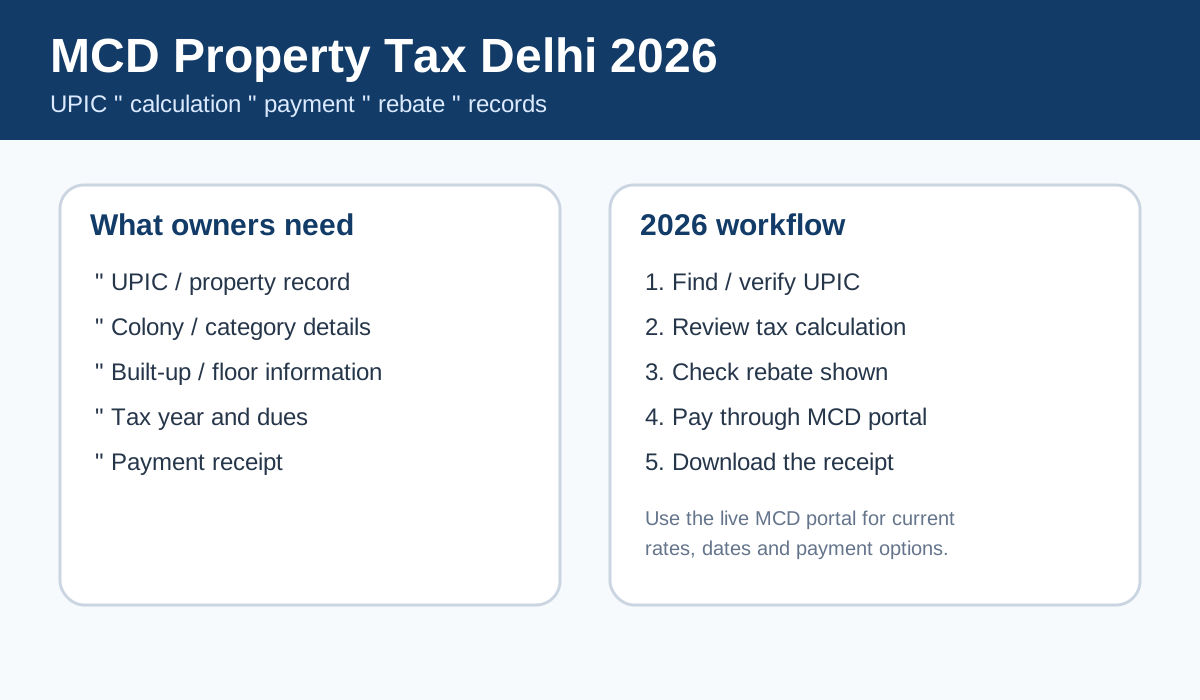
What Is MCD Property Tax in Delhi?
MCD property tax is the municipal tax payable on properties assessed within the Municipal Corporation of Delhi. MCD’s unified online portal provides property-tax services including property-tax filing, payment and receipt access. The portal uses a 15-character Unique Property Identification Code (UPIC) for property-tax records and payments.
The MCD property-tax system is separate from Delhi’s stamp duty and property registration charges. A property can therefore have both a municipal property-tax liability and separate transaction charges when it is sold or registered.
For buyers, this distinction matters because unpaid property-tax dues may become part of the practical due-diligence discussion before a sale.
Who Has to Pay Property Tax in Delhi?
Owners of properties within the MCD assessment area are generally responsible for the applicable property tax. The actual amount depends on the property and the rules used for its assessment.
Property-tax treatment can differ based on factors such as:
- Property use
- Colony/category
- Covered or built-up area
- Age and structure
- Occupancy or letting status
- Applicable rebates or exemptions
- Previous dues, interest or penalties
That is why two homes with similar market prices can have different MCD property-tax liabilities.
What Is a UPIC Number in Delhi Property Tax?
UPIC means Unique Property Identification Code. MCD’s property-tax FAQ describes a 15-digit alphanumeric UPIC as mandatory for property-tax payment. New taxpayers can register on the MCD portal and apply for a new UPIC when the property does not already have one.
Your UPIC is useful because it connects the online tax record with the property being assessed. Keep it with your property documents just as you would keep the sale deed, conveyance deed, allotment papers and registration records.
How Do You Find Your MCD UPIC Number?
If you already have an MCD tax receipt, the UPIC may appear on the property-tax record. For properties where the UPIC is not readily available, the MCD portal provides property-search and UPIC-related services.
The practical workflow is:
- Open the official MCD property-tax portal.
- Use the property/UPIC search option.
- Check the owner and address details.
- Save the displayed UPIC.
- Verify that the record actually corresponds to the property you own.
Do not assume a broker’s old receipt or another family member’s property-tax number belongs to the same property.
How Is MCD Property Tax Calculated in Delhi?
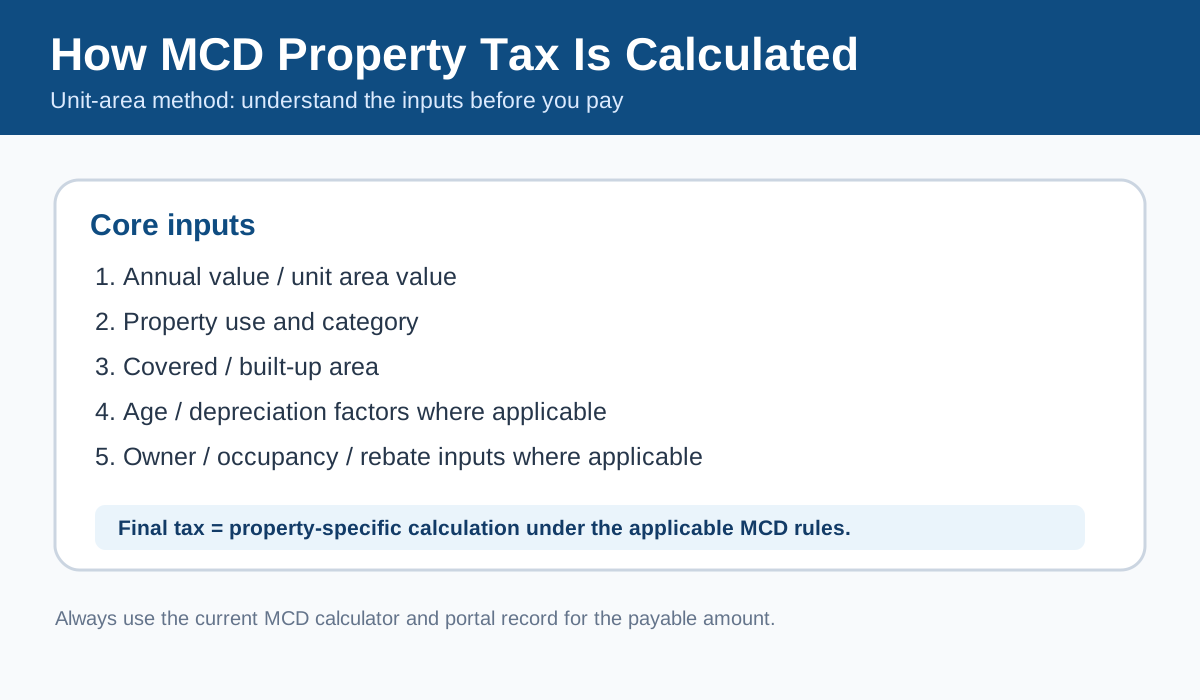
MCD uses the Unit Area System to calculate property tax. The assessment depends on the property’s covered area and the applicable unit-area value and factors, rather than simply taxing the current market value of the property. Current explanations of the MCD system describe factors such as colony category, unit-area value, age, use, structure and occupancy.
A simplified way to understand the system is:
Annual value / assessed value → applicable tax rate → rebates or other adjustments → net property tax payable
The exact calculation can be more detailed because the portal can show multiple components, including current demand, previous arrears, interest, fines/penalties, rebates and other applicable items. MCD’s own payment manual illustrates this tax-calculation structure.
What Factors Affect MCD Property Tax?
| Factor | Why it matters |
|---|---|
| Colony category | Different categories have different unit-area values and related assessment rules. |
| Covered/built-up area | Area is a core input into the annual-value calculation. |
| Property use | Residential, commercial and other uses can be taxed differently. |
| Age factor | Applicable age/depreciation treatment can affect annual value. |
| Structure/use/occupancy factors | These can change the applicable assessment. |
| Rebate | Eligible rebates reduce the payable tax. |
| Arrears / interest / penalty | Past non-payment can increase the amount shown as due. |
How Do You Calculate Delhi MCD Property Tax Online?
You do not need to manually reproduce every factor to pay the tax. The MCD portal generates a property-specific calculation once the record and relevant assessment information are available.
A practical self-check is:
- Confirm the property record.
- Confirm the UPIC.
- Check the tax year.
- Review the property details used in the calculation.
- Check current demand.
- Look for arrears, interest or penalties.
- Review rebates or concessions shown by the portal.
- Compare the net amount with your previous receipt.
If a major amount changes unexpectedly, investigate the property record before simply making payment.
What Is the MCD Property Tax Payment Process for 2026?
The MCD portal supports online filing and payment. MCD’s FAQ explains that a new taxpayer registers on the portal, obtains a UPIC, files the online self-assessment return and then pays the applicable tax; a successful payment generates a tax receipt.
Step 1: Open the official MCD portal
Use the official MCD website rather than an unofficial payment page.
Step 2: Log in or register
Use the registration/login method supported by the current portal.
Step 3: Find or enter the UPIC
Verify the property details before continuing.
Step 4: Select the financial year
Choose the relevant tax year and review the demand.
Step 5: Review the calculation
Check current tax, arrears, interest, penalty and rebate components.
Step 6: Make payment
Use the payment modes available on the official portal.
Step 7: Download the receipt
Save the receipt locally and in your property-document folder. MCD’s digital-service description includes property-tax payment and receipt downloading among the portal’s services.
What Was the MCD Property Tax Rebate Deadline for FY 2026-27?
For FY 2026-27, MCD officially extended the last date for the 10% rebate on lump-sum property-tax payment to July 31, 2026. That date has already passed as of September 29, 2026.
This is important when reading older 2026 blog posts: many still present June 30 or July 31 as if it were an upcoming deadline. It is not. For any current payment, extension or next rebate window, check the live MCD portal and latest MCD order rather than relying on a dated article.
Does MCD Give an Online Payment Rebate?
Rebate structures can depend on the financial year, property category and payment conditions. Some current third-party summaries describe additional online-payment rebates for qualifying residential properties, but these should not be treated as permanent rules. Use the rebate displayed in the current MCD demand/payment flow and the latest MCD order as the controlling source.
What Happens If You Do Not Pay MCD Property Tax?
Unpaid property tax can result in outstanding dues and, depending on the applicable rules and period, interest, penalties or other recovery consequences. MCD’s own tax-calculation system explicitly separates current demand, previous arrears, interest and fines/penalties, demonstrating why an overdue account can be different from a current-year-only payment.
For a property owner, the safest approach is to keep the account current and retain proof of payment.
What If Your MCD Property Tax Details Are Wrong?
Do not make a payment against a clearly incorrect property record without first understanding why the data is wrong.
Common issues include:
- Wrong owner name
- Incorrect property address
- Incorrect covered area
- Wrong property use/category
- Duplicate property record
- Old ownership information
- Incorrect arrears
- UPIC mismatch
Collect the supporting property documents and use the current MCD correction/grievance process. Keep copies of submissions and acknowledgements.
Can Property Tax Be Linked to Property Ownership Records?
Property-tax records and property-ownership documents serve different purposes, but they often interact during a real estate transaction. A buyer should compare the MCD property record with the sale deed, previous title documents, municipal details and seller information.
A mismatch does not automatically mean the title is defective, but it is a reason to investigate before paying token money or signing the final deed.
Does MCD Property Tax Matter When Selling a Delhi Property?
Yes, it can matter during transaction due diligence.
Before selling, it is sensible to:
- Check current property-tax dues.
- Clear known outstanding amounts where required.
- Download recent receipts.
- Resolve obvious owner/property mismatches.
- Keep the UPIC available.
- Provide the buyer with the supporting municipal record where relevant.
Buyers can use the tax record as one piece of the broader document-review process alongside title, registration, encumbrance and property documentation.
MCD Property Tax vs Stamp Duty: What Is the Difference?
| Charge | Paid to | When it matters |
|---|---|---|
| MCD property tax | Municipal Corporation of Delhi | Recurring property ownership/assessment obligation. |
| Stamp duty | Delhi government / registration framework | Property transactions and relevant legal instruments. |
| Registration fee | Registration department | Registration of applicable property instruments. |
For stamp duty and registration, see Credestate’s Delhi Circle Rate 2026 and Property Registration in Delhi 2026 guides.
What Documents Should a Delhi Property Owner Keep for MCD Tax?
- UPIC details
- Property-tax receipts
- Previous payment records
- Sale deed / conveyance deed
- Allotment or DDA documents where applicable
- Mutation or municipal record documents where applicable
- Property address proof
- Documents supporting any correction
- Payment transaction references

What Should You Do If Your UPIC Is Missing?
Start with the official MCD property-tax portal and use the available property/UPIC search route. If the property is genuinely not registered for tax purposes, the MCD FAQ instructs new taxpayers to register and apply for a new UPIC.
For a newly acquired property, do not wait until the next sale or transfer to discover that the municipal record was never properly set up.
MCD Property Tax Checklist for Delhi Property Owners
- Find your UPIC.
- Confirm owner name.
- Confirm property address.
- Confirm covered area.
- Confirm property category/use.
- Check the current financial year.
- Review arrears.
- Review interest and penalties.
- Check eligible rebate/concession shown by MCD.
- Pay through the official MCD portal.
- Download the receipt.
- Store the receipt with the property title documents.
Frequently Asked Questions About MCD Property Tax in Delhi
What is MCD property tax in Delhi?
MCD property tax is the municipal property tax assessed on properties within MCD jurisdiction. The amount depends on the applicable property-tax assessment rules and the property’s characteristics.
What is a UPIC number?
UPIC is the Unique Property Identification Code used by MCD for property-tax records and payment. MCD’s FAQ describes a 15-digit alphanumeric UPIC as mandatory for tax payment.
How do I pay MCD property tax online?
Use the official MCD property-tax portal, log in or register, locate the property using its UPIC, review the tax demand for the relevant financial year, pay through the available payment method and download the receipt.
What was the 2026 MCD property-tax rebate deadline?
MCD extended the 10% rebate deadline for lump-sum payment for FY 2026-27 to July 31, 2026. That deadline has passed, so current readers should check MCD’s latest notice for any active rebate or extension rather than relying on an old deadline. citeturn648157search0
How is MCD property tax calculated?
MCD uses the Unit Area System, with the assessment influenced by inputs such as unit-area value, property area, category and applicable factors such as age, use, structure and occupancy.
What if my MCD property-tax record is incorrect?
Collect documents proving the correct owner, address, area or property details and use MCD’s current correction/grievance route. Do not assume paying an incorrect demand will correct the underlying record.
Does MCD property tax matter when buying property in Delhi?
Yes. It is one of the municipal records a buyer can review during property due diligence, especially when checking outstanding dues and whether the municipal property information broadly aligns with the seller’s documents.
Final Takeaway: Keep the Municipal Record as Clean as the Title Record
MCD property tax should be treated as part of the property’s ongoing administrative record, not as an annual payment you forget after clicking “Pay”. Keep the UPIC correct, review the assessment, pay through the official channel, save receipts and correct obvious record errors early.
For buyers and sellers, the tax record should sit alongside the sale deed, registration record, circle-rate information and title documents. That becomes especially important when the property is later sold, financed or transferred.
Continue with Credestate’s Property Registration in Delhi 2026, Delhi Circle Rate 2026 and Delhi Property Documents Checklist.
Browse Credestate property listings in Delhi when you are ready to compare properties.
Disclaimer: MCD property-tax rates, rebates, deadlines, portal workflows and correction procedures can change. This guide is informational and does not replace the current MCD notice or property-specific assessment. Check the live MCD portal before making payment.



Join The Discussion