
Last updated: September 29, 2026
Credestate is a Delhi-focused property platform helping buyers compare homes, understand property costs and navigate the purchase process. Our Delhi property guides connect pricing, documentation, registration, financing and live listings so buyers can evaluate the complete transaction rather than one headline number.
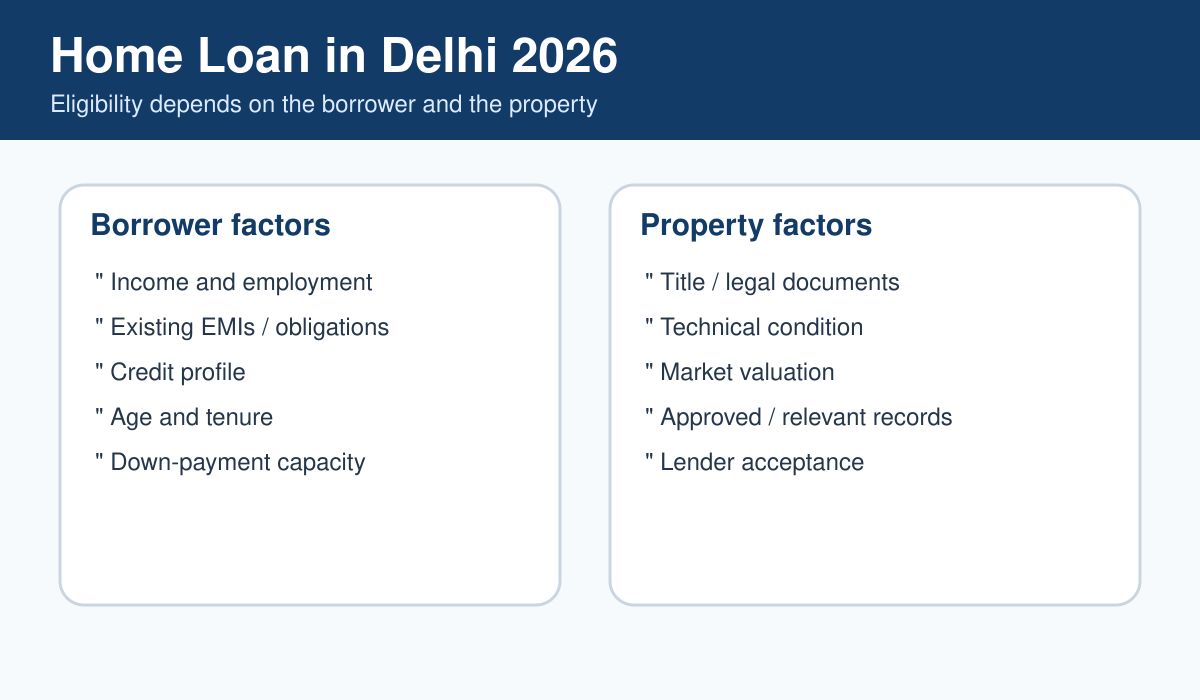
Searching for a home loan in Delhi 2026 is not just a question of finding the lowest advertised interest rate. A lender will look at your income, existing obligations, credit profile, age and repayment capacity, while the property itself must also pass legal, technical and valuation checks.
That becomes especially important in Delhi because buyers can be choosing between DDA flats, apartments, cooperative housing, builder floors, resale properties and other property structures with very different documentation profiles.
This 2026 guide explains how home-loan eligibility works, what documents lenders commonly request, how Delhi property documentation affects approval, how to compare offers, what happens after sanction, why sanction is not the same as disbursement, and how to calculate the real cash you need before buying.
What Is a Home Loan in Delhi in 2026?
Quick answer: A home loan in Delhi in 2026 is secured housing finance used to purchase, construct or improve an eligible property. Approval depends on both the borrower’s repayment capacity and the property’s legal, technical and valuation profile, so a strong income profile does not guarantee finance for every Delhi property.
How Credestate Built This Delhi Home Loan Guide
This guide separates general borrower principles from lender-specific examples. The framework uses RBI consumer guidance, current lender documentation and pricing pages, and Delhi property-registration and valuation information. We also connect the loan process to the property-document issues a Delhi buyer actually faces in resale apartments, builder floors and DDA properties.
What Is a Home Loan in Delhi 2026?
A home loan in Delhi 2026 is a secured housing loan used to purchase, construct or otherwise finance an eligible residential property, subject to the lender’s borrower, property and documentation requirements. The approval decision normally considers both the applicant’s repayment capacity and the property offered as security.
The borrower’s side includes income, liabilities, repayment capacity and credit history. The property’s side can include title documents, previous ownership chain, approvals, valuation, technical condition and the lender’s ability to create a valid mortgage. HDFC’s current 2026 home-loan documentation guidance explicitly notes that legal, title, ownership and technical issues can affect processing.
Who Is Eligible for a Home Loan in Delhi 2026?
There is no single nationwide income number that guarantees approval. Lenders apply their own policies and assess the applicant’s ability to repay.
Core factors generally include:
| Factor | Why lenders care |
|---|---|
| Income | Determines repayment capacity. |
| Employment/business stability | Helps establish continuity of earnings. |
| Existing EMIs | Reduces the amount available for a new loan. |
| Credit history | Shows repayment behaviour and risk history. |
| Age | Influences the permissible repayment tenure. |
| Down payment | Determines the amount that needs to be financed. |
| Property value | Lender valuation and policy can limit the loan amount. |
| Property documentation | Legal/technical issues can delay or prevent sanction/disbursement. |
The RBI’s consumer guidance on housing loans explains that banks assess repayment capacity using disposable/surplus income and factors such as income, expenses, spouse’s income, assets, liabilities and income stability. RBI housing-loan consumer guidance provides the underlying framework.
How Much Home Loan Can You Get in Delhi in 2026?
There is no single home-loan amount that applies to every Delhi buyer in 2026. The practical borrowing limit is shaped by income, existing EMIs, credit profile, age, loan tenure, lender policy and the value the lender accepts for the property.
The actual amount depends on the lender’s underwriting, your repayment capacity and the property transaction.
Think about the borrowing ceiling using three separate limits:
- Income-based capacity — what your monthly cash flow can realistically service.
- Property-based capacity — what the lender is willing to finance against the property’s accepted value.
- Policy-based capacity — what the lender’s current credit, risk and product rules permit.
The lowest of these practical ceilings often determines the usable loan amount.
Is There a Minimum Salary for a Home Loan in Delhi?
Quick answer: There is no single Delhi-wide minimum salary that guarantees a home loan. Lenders assess income together with existing obligations, credit history, age, tenure and the proposed property. Two borrowers earning the same salary can qualify for different loan amounts because their EMIs, liabilities and lender profiles are different.
What Is FOIR in Home Loan Eligibility?
FOIR (Fixed Obligations to Income Ratio) is a lender’s way of assessing how much of your income is already committed to fixed financial obligations. Existing EMIs and other obligations can reduce the amount of new home-loan debt a lender is comfortable approving.
What Is LTV in a Home Loan?
LTV (Loan-to-Value) compares the loan amount with the lender-accepted property value. A higher required own contribution can result when the lender will not finance the full purchase value. The exact LTV and product conditions depend on the lender and transaction.
What Credit Score Is Needed for a Home Loan?
Lenders generally prefer a stronger credit profile because it can improve the assessment of repayment risk, but there is no single credit-score cut-off that guarantees approval across every borrower and lender.
For example, ICICI Bank’s September 2026 home-loan pricing page publishes different rates based on credit score and borrower profile, while Axis Bank’s current home-loan page also shows different rates based on borrower profile and credit history. This demonstrates why the interest rate is borrower-specific rather than a universal Delhi rate.
Before applying:
- Check your credit report.
- Correct inaccurate information.
- Clear overdue balances where possible.
- Avoid unnecessary new credit applications.
- Keep credit-card utilization under control.
What Documents Are Needed for a Home Loan in Delhi 2026?
Home loan documents in Delhi 2026 normally fall into three groups: borrower KYC, income evidence and property documents. The exact list varies by lender and borrower profile.

Lenders typically divide the documentation into borrower/KYC, income and property documents.
For salaried borrowers
HDFC’s current home-loan checklist includes PAN/Form 60, identity/address proof, recent salary slips, bank statements showing salary credits, Form 16 and income-tax returns. HDFC’s current document checklist provides lender-specific examples.
For self-employed borrowers
Documentation can include income-tax returns, financial statements, business bank statements, KYC and other records needed to establish sustainable income. Additional documents may be requested based on the borrower and business structure.
For co-applicants
Each applicant/co-applicant may need a separate KYC and income-document set depending on how the lender assesses the application.
What Property Documents Are Needed for a Home Loan in Delhi?
Property documentation can be as important as your salary documents.
| Property type | Common lender requirements |
|---|---|
| New project / developer sale | Allotment letter, buyer agreement, payment receipts and project/legal approvals required by the lender. |
| Resale apartment | Title deeds, previous chain, agreement to sell and seller/property records. |
| Builder floor | Land/title chain, construction documents and approvals can require closer review. |
| Construction | Plot title, approved plans, no-encumbrance evidence and construction estimate. |
HDFC’s current checklist explicitly calls for title deeds and the previous chain for resale homes, while construction cases can require plot title, no-encumbrance proof, approved plans and an architect/civil-engineer estimate. See HDFC’s current documentation list.
This is one reason Credestate’s Delhi property document checklist should be read before submitting a loan application.
Does the Property Have to Be Bank-Financeable?
Yes, in practical terms. A borrower can meet the income requirements and still face problems if the property has title, approval, valuation or technical issues that the lender cannot accept.
HDFC explicitly advises applicants to verify that the property is free from material legal/title/ownership issues and that statutory approvals and sanctioned building plans are available.
This matters especially in Delhi resale transactions where documentation can vary dramatically from one property to another.
How to Apply for a Home Loan in Delhi 2026?
To apply for a home loan in Delhi 2026, first calculate your safe budget, check your credit profile, prepare KYC and income documents, identify a financeable property, compare lender offers, submit the application and complete the lender’s legal, technical and valuation checks before sanction and disbursement.
How Does the Home Loan Process Work in Delhi?

Step 1: Fix the purchase budget
Do not start with “How much will the bank give me?” Start with “How much can I safely spend?”
Your budget should include:
- Down payment
- Stamp duty
- Registration charges
- Brokerage where applicable
- Parking or society charges
- Immediate repairs/interiors
- Emergency reserve
- Loan processing/legal/technical charges
Step 2: Check your credit and documents
Review the borrower file before making a property commitment.
Step 3: Compare lenders
Compare the actual interest rate offered to your profile, processing fee, legal/technical charges, reset mechanism for floating loans, insurance conditions, prepayment terms and customer-service process.
Step 4: Apply
Submit the application and borrower documents.
Step 5: Income and credit assessment
The lender evaluates repayment capacity, credit information, liabilities and profile.
Step 6: Legal and technical property assessment
The lender reviews the property documents and often orders legal/title and technical/valuation assessments.
Step 7: Sanction
If approved, the lender issues sanction terms. Read the sanctioned amount, interest rate, tenure, conditions and charges carefully.
Step 8: Agreement and mortgage formalities
Complete the lender’s documentation and security/mortgage requirements.
Step 9: Disbursement
Funds are released subject to the lender’s pre-disbursement conditions.
What Is the Difference Between Home Loan Sanction and Disbursement?
Sanction is the lender’s approval subject to stated conditions; disbursement is the actual release of the approved loan amount. A loan can therefore be sanctioned while the property transaction is still waiting for documentation, registration or another pre-disbursement condition.
Sanction means the lender has approved the loan subject to stated terms and conditions; disbursement means the approved loan amount is actually released.
A property transaction can therefore reach sanction and still face a delay before disbursement if documentation, registration, construction stage, own-contribution proof or another lender condition is incomplete.
This distinction is particularly important when you have committed to a seller’s payment schedule.
What Are Home Loan Interest Rates in Delhi 2026?
Home loan interest rates in Delhi 2026 are lender- and borrower-specific rather than one fixed Delhi rate. Credit profile, loan amount, product, tenure and lender policy can change the rate quoted to an individual applicant.
There is no single “Delhi home loan rate.” Interest depends on lender, loan product, borrower profile, credit score, loan amount, tenure and whether the loan is fixed or floating.
As of September 2026, for example, ICICI publishes standard home-loan rates in a range around 8.50%–9.65% depending on loan slab and borrower profile, while its special pre-approved digital rates can start lower; Axis publishes current floating-rate ranges that also vary with credit score and profile. These figures are lender-specific examples, not a universal market rate or recommendation.
For an actual purchase, compare the personalized written offer rather than a headline starting rate.
How Does the Interest Rate Change Your EMI on a Home Loan in Delhi 2026?
Even a small change in interest rate can change the total interest paid over a long tenure.
For example, on a hypothetical ₹60 lakh loan over 20 years:
| Illustrative rate | Approx. EMI | Interpretation |
|---|---|---|
| 8.0% | ~₹50,200 | Illustrative only |
| 8.5% | ~₹52,000 | Illustrative only |
| 9.0% | ~₹53,992 | Illustrative only |
Actual EMI depends on the lender’s exact rate, repayment schedule and loan structure.
How Much Down Payment Do You Need for a Delhi Property?
Your down payment is the portion of the purchase cost you fund from your own resources rather than the home loan.
Do not calculate it as simply:
Property price − loan amount
A more realistic cash requirement is:
Own contribution + stamp duty + registration + transaction costs + immediate property expenses + reserve
This is why a buyer who technically qualifies for a large loan can still be underfunded for the actual transaction.
How Should You Compare Home Loan Offers in Delhi?
Quick answer: Compare personalized loan offers on more than the headline interest rate. Check the sanctioned rate, reset mechanism, processing and legal/technical charges, prepayment terms, insurance requirements, documentation conditions and the conditions that must be completed before disbursement.
| Comparison point | What to verify |
|---|---|
| Interest rate | Personalized rate, benchmark/spread and whether it is fixed or floating. |
| Processing charges | Application, processing and administrative fees. |
| Legal/technical costs | Property legal opinion and valuation charges. |
| Prepayment | Current product terms for part-prepayment or closure. |
| Disbursement | Documents and transaction milestones required before funds are released. |
| Insurance | Whether insurance is optional, required or separately priced. |
What Are the Extra Costs of a Home Loan?
Depending on the lender and product, the loan can involve:
- Processing fee
- Legal opinion fee
- Technical valuation fee
- Documentation/administrative charges
- Government/statutory charges
- Insurance-related cost where applicable
- Late-payment/penal charges if you miss an obligation
- Prepayment or foreclosure charges where applicable to the specific product
HDFC and ICICI both publish separate schedules of home-loan charges, demonstrating why borrowers should review the lender’s complete fee schedule rather than comparing only the interest rate.
Should You Take a Fixed or Floating Home Loan?
A fixed-rate structure can provide more predictable payments for the fixed period covered by the product, while a floating-rate loan can change as the applicable benchmark, spread or lender pricing changes.
Compare:
| Factor | Fixed / fixed-period | Floating |
|---|---|---|
| Payment predictability | Higher during the fixed period | Can change over time |
| Potential benefit from falling rates | May require conversion/transition depending on product | Can benefit when pricing resets lower |
| Risk | Less rate uncertainty during the fixed period | More rate uncertainty |
| Best comparison | Read the full fixed-period and post-period terms | Read benchmark, spread and reset mechanism |
How Does a Delhi Property’s Circle Rate Affect Home Loans?
Circle rate and lender valuation are not the same thing.
A bank can perform its own legal and technical/market valuation while Delhi’s government circle rate is relevant to property-registration calculations. A buyer therefore needs to evaluate:
- Agreed sale consideration
- Government circle-rate value
- Lender’s accepted valuation
- Loan-to-value / lender funding policy
- Cash required to bridge any gap
For Delhi government valuation, see Credestate’s Delhi Circle Rate 2026 guide.
Can a Home Loan Be Used for DDA Flats in Delhi?
Financing depends on the specific DDA property, allotment/ownership status, lender policy and the documents required to create acceptable security.
Before assuming financing is available, confirm:
- Current allotment/ownership document
- Transfer/lease/tenure conditions
- Possession status
- Whether the lender accepts the specific DDA property
- Required NOCs or authority documentation
- Payment schedule
Read Credestate’s DDA Flats in Delhi 2026 guide alongside the lender’s property-document requirements.
How Should First-Time Buyers in Delhi Plan a Home Loan?
Use a five-stage readiness test:
- Budget: Can you cover the down payment and transaction costs?
- Credit: Is your credit history clean?
- Income: Is your cash flow stable enough for the EMI?
- Property: Can the property pass legal and technical review?
- Reserve: Can you handle repairs or an income disruption without missing EMIs?
The loan should fit the property and your life—not the other way around. A home loan in Delhi 2026 should be sized around sustainable cash flow, not the maximum amount a lender says you may qualify for.
What Can Delay a Delhi Home Loan?
| Problem | Typical consequence |
|---|---|
| Incomplete KYC/income documents | Application processing slows. |
| Existing overdue credit | Credit assessment becomes harder. |
| Title-chain gap | Legal review can stop until documents are clarified. |
| Unapproved construction | Technical/legal concerns can affect loan eligibility. |
| Valuation gap | Buyer may need more own contribution. |
| Seller document issue | Disbursement can be delayed. |
| Incorrect property description | Legal or technical review can require corrections. |
Home Loan in Delhi 2026: Buyer Checklist Before You Commit
Before signing a property agreement, use this home loan in Delhi 2026 checklist to test the transaction from both sides: borrower readiness and property financeability.
- Budget: Calculate down payment, stamp duty, registration and reserve.
- Credit: Check your credit report and current EMI obligations.
- Documents: Keep KYC, income and property records ready.
- Property: Verify title, approvals, valuation and seller authority.
- Lender: Compare the personalized rate, fees, reset terms and pre-disbursement conditions.
- Cash flow: Test the EMI against realistic monthly expenses.
Home Loan vs Buying With More Own Cash
The right comparison is not simply “interest versus no interest.” Consider:
- Liquidity retained after purchase
- Monthly EMI burden
- Expected holding period
- Opportunity cost of own capital
- Emergency reserve
- Tax treatment where applicable
- Flexibility to prepay
A buyer should avoid taking the maximum available loan merely because the lender offers it.
Delhi Home Loan Checklist Before Signing a Property Deal
- ☐ Credit report reviewed
- ☐ Existing EMI burden calculated
- ☐ Down payment available
- ☐ Stamp duty/registration budgeted
- ☐ Property title chain reviewed
- ☐ Property approved/financeable
- ☐ Lender comparisons obtained
- ☐ Interest rate and reset mechanism understood
- ☐ Processing/legal/technical charges understood
- ☐ Sanction conditions read
- ☐ Disbursement conditions understood
- ☐ Emergency reserve retained
Frequently Asked Questions About Home Loans in Delhi
How do I apply for a home loan in Delhi 2026?
Start by calculating a safe property budget, checking your credit profile, preparing KYC and income documents, shortlisting a financeable Delhi property, comparing personalized lender offers, and then completing the lender’s legal, technical and valuation process before sanction and disbursement.
How much home loan can I get in Delhi?
The amount depends on income, existing liabilities, credit profile, age, tenure, property value and the lender’s current underwriting policy. There is no single Delhi-wide loan amount that applies to every borrower.
What credit score is needed for a home loan?
A stronger credit profile generally improves the lender’s assessment, but each lender applies its own policies. Current lender pricing pages show that rates can vary with credit score and borrower profile.
What documents are required for a home loan in Delhi?
Common requirements include PAN/KYC, income proof, bank statements and tax documents for the borrower, plus title, sale/allotment and other property documents depending on whether the property is new, resale or under construction.
Can a bank reject a home loan because of the property?
Yes. Even when the borrower is financially eligible, legal title, ownership, approval, technical or valuation issues can affect a lender’s decision or disbursement.
What is the current home-loan interest rate in Delhi in 2026?
There is no single Delhi rate. Lenders price according to borrower profile, credit score, loan slab and product. For example, current September 2026 published rates differ materially across ICICI and Axis products.
Is home-loan sanction the same as disbursement?
No. Sanction is the approval on specified terms; disbursement is the actual release of funds after applicable conditions are satisfied.
Can I get a home loan for a builder floor in Delhi?
Potentially, but the lender’s legal and technical assessment is important. Land/title structure, sanctioned plans, construction documentation and seller ownership records can affect financeability.
Should I compare multiple home-loan lenders?
Yes. Compare personalized interest rate, processing fees, legal/technical charges, reset mechanism, prepayment terms and disbursement conditions rather than selecting a loan based only on an advertised starting rate.
Credestate and Home Buying in Delhi
Credestate is a Delhi-focused property platform helping buyers compare listings, property documents, registration costs and financing considerations. For local property enquiries, our office is at Ground Floor, Creative Heights, Rohini Sector 29, Delhi – 110039, India. Use this local context alongside the property-specific checks in this guide.
Contact Credestate for a Delhi property enquiry, or browse Delhi property listings.
Final Takeaway: Get the Property and the Loan Approved Together
A Delhi home loan is easiest when you treat borrower readiness and property readiness as one transaction. A strong income profile cannot rescue a property with unresolved title issues, just as a perfectly documented property does not guarantee approval if the borrower cannot comfortably service the loan.
Before paying serious token money, check your credit profile, calculate the total cash requirement, compare lender offers, review the property documents and understand the difference between sanction and disbursement. For a home loan in Delhi 2026, property financeability matters just as much as borrower eligibility.
For the broader purchase process, continue with Credestate’s Delhi Property Buying Checklist, Property Registration in Delhi 2026 and 2 BHK Flats in Delhi 2026 guide.
Browse Credestate property listings in Delhi when you are ready to compare properties.
About Credestate’s Delhi Property Research
Credestate publishes Delhi-focused property listings and buyer guides covering property prices, DDA housing, registration, circle rates, documents and home-buying decisions. Our Delhi office is at Ground Floor, Creative Heights, Rohini Sector 29, Delhi – 110039, India. For a property-specific enquiry, use the Credestate contact page.
Disclaimer: Home-loan rates, eligibility policies, lender charges, government rules and property-finance criteria can change. This article is for general informational purposes and is not financial, legal or tax advice. Verify the personalized lender offer and property-specific legal/technical requirements before signing a transaction.



Join The Discussion