

Buying a Freehold vs Leasehold Property in Delhi involves more than choosing the right locality, negotiating the price and comparing the size of different homes. Buyers should also understand what type of property rights they are actually acquiring.
One of the most important distinctions is freehold vs leasehold property in Delhi.
A property may look similar physically—a DDA flat, apartment, plot or house—but its underlying tenure and documentation can affect the buyer’s rights, future transfer, applicable dues, documentation and resale process.
In simple terms, freehold ownership generally gives the owner permanent ownership rights in the property without a fixed lease tenure, while a leasehold property is held under the terms of a lease granted by the land-owning/lessor authority for the applicable lease period.
However, that simple definition is not enough for a Delhi buyer.
You also need to understand:
Who owns the underlying land? How long is the lease? What conditions apply? Can the property be sold? Are there outstanding ground rent or other dues? Has a claimed freehold conversion actually been completed? What documents prove the property’s present status?
These questions become particularly relevant in Delhi because DDA has historically allotted properties under leasehold arrangements and also operates mechanisms concerning conversion of eligible properties from leasehold to freehold. DDA’s Housing Department states that conversion of allotted residential units/flats to freehold forms part of its work.
There is also an important 2026 development buyers need to know: DDA’s published archive states that the process of conversion from leasehold to freehold was put on hold till further orders.
We’ll explain what that means later in this guide.
CredEstate Buyer Rule: Don’t buy a property merely because the broker describes it as “freehold” or “leasehold.” Verify the property’s actual tenure and the documents supporting that status.
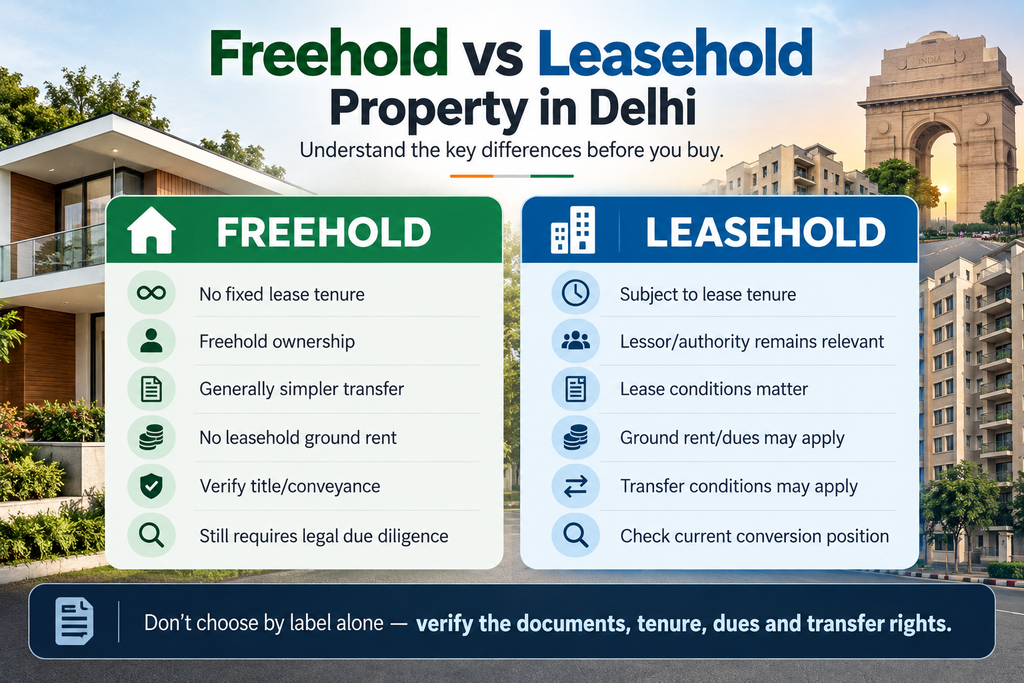
Freehold vs Leasehold Property in Delhi: Quick Comparison
If you want the short answer before going deeper, here’s the basic difference:
| Factor | Freehold Property | Leasehold Property |
|---|---|---|
| Nature of rights | Property is held without a fixed lease tenure | Rights are governed by a lease |
| Underlying land | Freehold interest is held by the owner | Underlying land remains with the lessor/land-owning authority |
| Duration | Not limited by a lease term | Subject to applicable lease period |
| Transfer | Generally more straightforward, subject to applicable law/documentation | Transfer may be affected by lease conditions and applicable authority requirements |
| Ground rent | No continuing leasehold ground rent merely because of tenure | Ground rent/lease-related dues may apply depending on the lease |
| Documentation | Title/conveyance documents establish freehold status | Lease deed/allotment and related records become particularly important |
| Conversion | Already freehold | Certain eligible properties may have mechanisms for conversion |
| Buyer due diligence | Title, seller, approvals, mortgage, dues etc. | Same checks plus lease terms, tenure, lessor requirements and lease-related dues |
| Resale | Often administratively simpler | May involve additional tenure/authority considerations |
| Best option? | Often preferred for simpler long-term ownership | Can still be a valid purchase if rights, tenure and documentation are understood |
The most important point is:
Leasehold does not simply mean “rented property,” and freehold does not mean “no legal verification required.”
Both can require extensive due diligence before purchase.
What Is Freehold Property in Delhi?
A freehold property is generally one in which the owner holds the property without the ownership being limited to a fixed lease term granted by a superior lessor.
In practical terms, this usually gives the owner greater independence in dealing with the property compared with a leasehold arrangement, although normal laws, building regulations, planning restrictions, mortgages and other legal obligations can still apply.
For example, suppose you purchase a freehold residential property through an appropriate registered conveyance.
Your ownership isn’t scheduled to end simply because a 99-year lease period expires.
But there is an important misunderstanding to avoid:
Freehold does not mean unrestricted freedom to do anything with the property.
A freehold owner cannot automatically construct additional floors, change land use, encroach on public land or ignore applicable building regulations merely because the property is freehold.
Ownership rights and construction/planning permissions are different issues.
That distinction will make this article stronger than many generic “freehold is full ownership” explanations currently ranking.
What Documents Can Establish Freehold Status?
Don’t rely solely on:
“Broker said it is freehold.”
Depending on the property’s history, relevant documentation can include an applicable Sale Deed, Conveyance Deed, previous title documents and leasehold-to-freehold conversion/conveyance documentation where the property was converted.
For a converted DDA property, buyers should understand how the property moved from:
Original allotment → Leasehold status → Conversion process → Conveyance/freehold documentation → Subsequent transfers → Current seller
DDA’s current Housing pages specifically maintain resources relating to conversion of leasehold properties to freehold.
So when a seller says:
“This DDA property was converted to freehold years ago.”
your response should be:
“Please show me the documentation establishing that conversion and the subsequent ownership chain.”
What Is Leasehold Property in Delhi?
In a leasehold property, rights in the property are held under a lease from the land-owning or lessor authority for the applicable lease period and subject to the terms of that lease.
The lease document becomes important because it can contain conditions concerning matters such as:
tenure → ground rent → permitted use → transfer → breaches → dues → other obligations of the lessee.
This is why buyers should not judge a leasehold property solely by looking at how many years remain.
The more useful questions are:
Who is the lessor?
What rights were granted?
What is the lease period?
What conditions govern transfer?
Are there outstanding dues or breaches?
Has the lease ever been cancelled, restored, modified or converted?
Does the seller actually have authority to transfer the rights being offered?
DDA’s current FAQs, for example, specifically discuss lease-related breaches and restoration of cancelled leases, showing why the actual lease status can matter rather than simply seeing the word “leasehold” on a document.
Is a Leasehold Property the Same as Renting a House?
No.
This is one of the most useful FAQ/snippet opportunities for the article.
A buyer acquiring a leasehold interest is not necessarily in the same position as a tenant taking a normal residential property on rent.
A leasehold property can involve valuable long-term transferable property rights, but those rights remain subject to the applicable lease and its conditions.
Therefore:
Tenant under normal rental agreement ≠ purchaser/holder of a long-term leasehold property interest.
The correct question isn’t:
“Do I own it or am I renting?”
It’s:
“Exactly what rights am I acquiring under the property’s title and lease documents?”
Is Freehold Property Better Than Leasehold Property in Delhi?
For many residential buyers, freehold can be preferable because it removes the additional layer of a continuing leasehold relationship and its associated tenure conditions.
But that doesn’t mean:
Freehold = automatically good property
Leasehold = automatically bad property
Consider two properties:
Property A: Freehold, but the seller has an unresolved title dispute.
Property B: Leasehold, with a clear documented chain, substantial remaining tenure, compliant lease position and properly understood transfer requirements.
You should not automatically choose Property A merely because someone has labelled it “freehold.”
The correct comparison is:
Tenure + title + seller authority + documentation + approvals + dues + mortgage + physical property + price
—not tenure alone.
This gives us the central answer for the article:
For buyers seeking simpler long-term ownership, a properly documented freehold property is generally preferable. However, a properly documented leasehold property can still be a legitimate purchase when the buyer understands the remaining tenure, lease conditions, transfer requirements, dues and current conversion position.
Important 2026 Update: DDA Leasehold-to-Freehold Conversion
This section is critical for ranking this article in 2026. DDA continues to publish information and resources concerning its leasehold-to-freehold conversion framework. Its Housing information says conversion of allotted residential units/flats to freehold is voluntary and describes the process as online. However, buyers need to know about the more recent policy development.
DDA’s current archive contains the notice:
“The process of conversion from leasehold to freehold has been put on hold till further orders.”
So we should not tell readers in 2026:
“Just buy the leasehold property and convert it to freehold afterward.”
That would be too simplistic.
Instead:
If your purchase decision depends on future conversion, verify the current DDA position directly before committing to the transaction.
DDA’s current site still provides conversion-related resources, and its FAQs describe online conversion procedures, charges and dues. This means buyers should distinguish between the broader conversion framework, the status of a particular existing application, and whether new/current processing is available under the latest DDA directions.
Official DDA resources
DDA Leasehold-to-Freehold FAQs
Can Outstanding Dues Affect Freehold Conversion?
Yes, this deserves a short section because it is directly supported by DDA’s current guidance.
DDA states that conversion is allowed only after applicable dues are paid. Its FAQ identifies examples including applicable ground rent, service/maintenance charges, misuse/damage-related charges and other dues depending on the property.
DDA also states that conversion is not allowed where the matter is sub judice or where there is encroachment on government land.
Therefore, if a seller tells you:
“Conversion is just a formality.”
don’t accept that as a substitute for verification.
When discussing document verification:
When discussing property choice:
Freehold vs Leasehold Property in Delhi for Home Loans
One of the most common questions buyers ask is whether banks provide home loans for leasehold properties in Delhi.
The short answer is:
Both freehold and leasehold properties may be eligible for home-loan financing, but the lender will assess the specific property’s title, remaining lease tenure, documentation and other eligibility factors.
Freehold property is often more straightforward from a documentation perspective because there is no continuing lease tenure to examine. However, being freehold does not automatically guarantee loan approval.
The lender may still examine the property’s title, ownership chain, approved plans, seller documentation, valuation and other applicable records.
For a leasehold property, additional attention may be given to matters such as:
- remaining lease tenure;
- identity of the lessor/authority;
- lease conditions;
- transferability;
- applicable permissions or requirements;
- outstanding lease-related dues;
- title/documentation; and
- whether the loan tenure is appropriate relative to the remaining lease period.
Example
Suppose you are comparing two Delhi properties:
Property A
Freehold property worth ₹1 crore with a disputed title.
Property B
Leasehold property worth ₹90 lakh with substantial remaining tenure and properly documented rights.
The word “freehold” alone does not make Property A more financeable.
The lender will assess the actual legal and financial characteristics of the property.
CredEstate Buyer Rule: Never pay token money merely because a broker says, “Bank loan ho jayega.” Obtain clarity about the property’s documentation and your lender’s requirements independently.
Freehold vs Leasehold Property in Delhi for Resale
Resale is another area where freehold property can have a practical advantage.
A properly documented freehold property in Delhi is generally simpler to understand from a tenure perspective because the buyer doesn’t need to evaluate an ongoing lease term or continuing lessor relationship merely because of the tenure structure.
With leasehold property, a prospective buyer may additionally want to understand:
remaining lease period → transfer conditions → lessor requirements → ground rent/dues → breaches, if any → current conversion position.
This additional investigation can influence how easily future buyers and lenders evaluate the property.
However:
Leasehold does not mean “cannot be resold.”
The actual ability and process to transfer a leasehold property depends on the applicable lease, documentation, authority requirements and circumstances.
Likewise:
Freehold does not mean “easy resale at any price.”
Location, property condition, legal title, construction status, demand, parking, accessibility, financing availability and market price can have a much greater effect on resale demand.
Does Freehold Property Have a Higher Value Than Leasehold?
You will often hear:
“Freehold property always costs more.”
That’s too broad to use as a property-investment rule.
All else being reasonably comparable, buyers may place a premium on the simpler and more permanent tenure characteristics of freehold ownership.
But property value in Delhi is influenced by many factors beyond tenure:
locality, plot/flat size, floor, construction quality, age, parking, road width, connectivity, amenities, legal status, market demand and comparable transactions.
For example, a well-located leasehold property in a highly desirable Delhi locality may command a much higher price than a freehold property in a substantially weaker location.
So instead of asking:
“Which is more expensive: freehold or leasehold?”
ask:
“How much of the price difference between these two comparable properties is actually attributable to tenure?”
That’s a much better investment question.
Ground Rent and Other Costs: Freehold vs Leasehold
This is one of the financial differences buyers should investigate before purchasing a leasehold property.
Depending on the lease and authority involved, a leasehold property may carry ground rent or other lease-related dues and obligations.
Before purchasing, establish:
What ground rent applies?
Has it been paid up to date?
Are there outstanding authority dues?
Are any misuse, damage, service or other applicable charges pending?
Could existing dues affect transfer or conversion?
As already discussed above, DDA’s conversion guidance specifically requires applicable dues to be cleared for conversion.
For a freehold property, the continuing leasehold ground-rent issue ordinarily falls away, but normal property expenses do not.
A freehold owner may still have:
property tax, society/RWA charges, maintenance costs, utility dues and other applicable liabilities.
Therefore:
Freehold does not mean “no recurring property costs.”
It primarily changes the nature of the tenure, not every financial obligation connected with owning property.
What Happens When a Leasehold Property’s Lease Expires?
This is an important long-tail search query and should remain in the article.
The answer depends on the actual lease terms, lessor, applicable law and authority policy.
A buyer should therefore avoid assuming either:
“The property automatically becomes freehold after the lease expires.”
or:
“The property automatically disappears from your ownership the next day.”
Instead, examine the particular lease to understand:
the original tenure, commencement date, remaining period, renewal/extension provisions where applicable, lessor rights and obligations of the lessee.
This becomes especially important when purchasing an older leasehold property.
If the remaining tenure is materially shorter than comparable properties, obtain professional advice and understand the lessor’s current rules before committing substantial money.
Can Freehold and Leasehold Property Be Inherited?
Property tenure and succession are related but separate questions.
Both freehold interests and leasehold rights may potentially pass through inheritance/succession, but what ultimately passes to successors depends on the rights held by the deceased owner/lessee and the applicable legal and documentary circumstances.
For leasehold property, successors remain subject to the relevant lease conditions and applicable authority requirements.
For either tenure type, buyers purchasing an inherited property should verify:
previous ownership → death/succession documentation → persons having rights → mutation/substitution where applicable → current seller’s authority to transfer.
Don’t assume that the person physically occupying an inherited property is automatically the only person entitled to sell it.
Freehold vs Leasehold for DDA Flats, Builder Floors and Apartments in Delhi
The practical importance of freehold vs leasehold property in Delhi can vary depending on the type of property you’re buying.
A DDA flat, independent builder floor and apartment in a group-housing project may have very different ownership histories and documentation. Buyers should therefore avoid applying the same checklist blindly to every property.
| Property Type | What Buyers Should Verify |
|---|---|
| DDA Flat | Allotment history, lease/conveyance documents, present freehold or leasehold status, mutation/substitution where applicable, dues and resale chain |
| Builder Floor | Land title, seller’s share/right in land and floor, Sale/Conveyance Deed, sanctioned building plan, parking/terrace rights and construction status |
| Society/Group Housing Apartment | Title/conveyance structure, society records, applicable lease/freehold status, dues, approvals and transfer requirements |
| Resale Property | Current title plus complete previous ownership chain, tenure status, mortgage, seller authority and applicable authority records |
The label “DDA flat” or “builder floor” by itself does not tell you whether a particular property is freehold or leasehold.
Freehold vs Leasehold for DDA Flats
DDA properties deserve particular attention because Delhi has a long history of properties allotted under leasehold arrangements, with eligible properties subsequently going through conversion/conveyance processes.
When considering a DDA resale property, establish its current status, rather than relying solely on its original allotment.
For example:
Originally leasehold → subsequently converted/conveyed as freehold
is materially different from:
Originally leasehold → still held under the applicable lease
If the seller claims the property is now freehold, examine the documents supporting that change.
Likewise, if it remains leasehold, understand the lease tenure, conditions, applicable dues and transfer requirements.
Because DDA’s published archive states that the leasehold-to-freehold conversion process has been put on hold till further orders, a buyer in 2026 should not base a purchase decision on an unsupported promise that:
“You can easily convert it after buying.”
Check the latest position directly with DDA if future conversion is important to your decision.
What About Builder Floors in Delhi?
Builder-floor buyers need to examine more than whether someone describes the property as “freehold builder floor.”
A builder floor involves both the individual floor being purchased and the underlying rights associated with the property/land.
Buyers should understand:
what exactly the Sale/Conveyance Deed transfers, the seller’s interest in the underlying land, the floor being transferred, common areas, parking rights, terrace/roof rights where claimed, and applicable construction approvals.
For example, a listing might advertise:
“Freehold third floor with exclusive terrace rights.”
The word freehold doesn’t independently establish the claimed terrace right.
The relevant title/conveyance documentation should support what the seller is actually promising.
CredEstate Buyer Rule: For a builder floor, verify both the property’s tenure and the specific rights attached to the floor you’re purchasing.
What About Apartments and Group Housing Societies?
An apartment buyer should not assume:
“It’s inside a society, so every flat must have exactly the same ownership documentation.”
The relevant structure can depend on the project, land tenure, conveyance arrangements and history of the particular apartment.
For a resale apartment, investigate the current owner’s title along with applicable:
conveyance/title documents, society records, transfer history, freehold/leasehold status, maintenance dues, mortgages and project/building approvals.
If the underlying property remains subject to a lease, understand the applicable conditions rather than treating the apartment exactly like a freehold property.
Can You Sell a Leasehold Property in Delhi?
A leasehold property is not automatically unsellable.
The ability and procedure to transfer it depend on the particular lease, applicable authority requirements and the seller’s rights.
Before purchasing a leasehold property with the intention of reselling it later, understand:
remaining tenure → transfer provisions → applicable permissions/formalities → outstanding dues → mortgage status → documentation required from the lessor/authority.
This is particularly important for investment buyers.
A property that appears cheaper today may not necessarily represent better value if its tenure or documentation creates significant difficulty for financing or future transfer.
Can You Renovate a Freehold Property Without Permission?
This is another misconception worth targeting for search traffic.
Freehold ownership does not mean unlimited construction rights.
Owning a property as freehold and obtaining permission for construction are separate matters.
Applicable building regulations, sanctioned plans, structural requirements, land-use restrictions and local-authority rules can still apply.
Therefore, purchasing a freehold property does not automatically give the owner the right to:
- add another floor;
- cover balconies;
- construct over setbacks;
- change permitted use; or
- make every structural alteration without applicable approvals.
Similarly, leasehold properties can have additional restrictions arising from the lease itself.
The correct question is therefore not:
“Is it freehold, so can I build whatever I want?”
but:
“What ownership rights do I have, and what construction or alteration is legally permissible?”
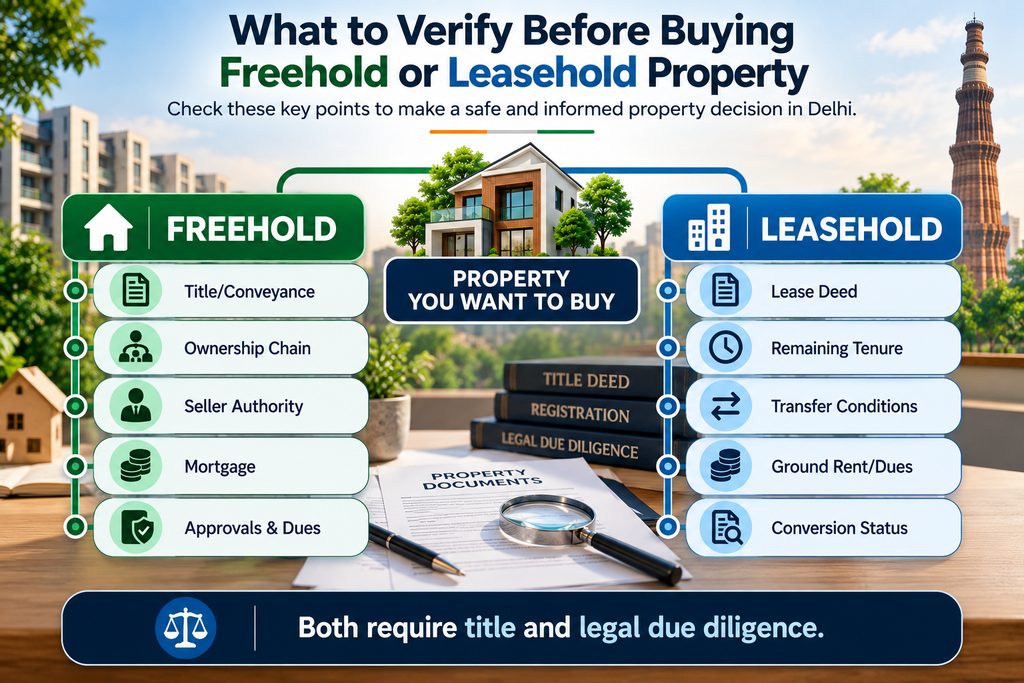
Documents to Check: Freehold vs Leasehold Property
Now we should give the reader a short actionable checklist, not repeat the entire property-document article.
| Freehold Property | Leasehold Property |
|---|---|
| Sale/Conveyance Deed | Lease Deed / applicable allotment documents |
| Previous title chain | Original allotment/lease history |
| Seller’s authority | Seller/lessee’s authority |
| Registration records | Remaining lease tenure |
| Mortgage/encumbrance checks | Transfer conditions |
| Sanctioned plan/approvals | Ground rent and lease-related dues |
| Property-tax/other dues | Breach/restoration status where relevant |
| Conversion documents if previously leasehold | Conversion status, if relevant |
| Mutation/supporting records where applicable | Mutation/substitution records where applicable |
| Physical-property verification | Physical-property verification |
For either tenure:
Don’t examine one document in isolation. Verify whether the documents collectively support the seller’s claimed rights and the property you’re actually purchasing.
Internal link here
This is the strongest location for your new document article:
For a complete title, mortgage, registration and approval checklist, read Documents to Check Before Buying Property in Delhi in 2026 before paying token money.
Link the bold text to that article once published.
Freehold vs Leasehold Property Red Flags
Regardless of which tenure you choose, investigate further when:
- The seller cannot clearly explain whether the property is freehold or leasehold.
- A broker says “freehold” but supporting conveyance/title documentation is unavailable.
- A leasehold property has an unclear remaining tenure.
- Ground rent or authority dues remain unexplained.
- The seller promises future conversion without checking the current authority position.
- Property documents describe one tenure while marketing material claims another.
- A claimed conversion cannot be supported by appropriate documentation.
- The seller avoids questions about lease conditions or transfer requirements.
- A builder-floor seller uses “freehold” to justify parking, terrace or construction rights that aren’t separately supported.
- You are pressured to pay token money before tenure and title verification.
CredEstate Red Flag: “Freehold” is not a substitute for a clean title, and “leasehold” is not automatically a defective title.
Which Is Better: Freehold or Leasehold Property in Delhi?
For most buyers planning to hold a property for the long term, a properly documented freehold property will generally be the simpler option because there is no continuing lease tenure to evaluate.
However, the right choice depends on more than the words freehold and leasehold.
A buyer should compare:
Title + tenure + remaining lease period + documentation + location + price + financing + dues + future resale potential
A good leasehold property should not automatically be rejected merely because a comparable property is freehold. Similarly, paying a substantial premium for freehold ownership may not make sense if the underlying property has weaker location, title, construction or resale characteristics.
Which Type Is Better for Different Buyers?
| Buyer | Usually Preferable | Why |
|---|---|---|
| Long-term self-use buyer | Freehold | Simpler permanent tenure and fewer lease-related considerations |
| Family planning generational ownership | Freehold | No fixed lease tenure to consider |
| Buyer comparing similar properties | Freehold | Often simpler when price, location and legal status are otherwise comparable |
| Budget-conscious buyer | Compare both | A properly documented leasehold property may still offer value |
| Investor | Depends | Price, rental yield, location, resale demand and tenure all matter |
| Buyer considering older leasehold property | Extra caution | Remaining tenure and lease conditions become increasingly important |
| DDA property buyer | Verify first | Establish actual current freehold/leasehold status and documentation |
| Buyer depending on future conversion | Extra caution in 2026 | Don’t assume future conversion will be immediately available |
Bottom line: If two otherwise comparable Delhi properties are legally sound, similarly priced and equally suitable, the freehold property will often be the more straightforward long-term choice.
When Can a Leasehold Property Still Be Worth Buying?
A leasehold property can still make sense when:
- substantial lease tenure remains;
- the title and lease documentation are clear;
- transfer is permissible under the applicable terms;
- relevant dues are clear;
- financing is available on acceptable terms;
- the location/property is significantly better;
- the purchase price appropriately reflects the tenure; and
- you understand the implications for future resale.
For example, imagine:
Freehold Property A: ₹1.20 crore
Average location, weaker rental demand.
Leasehold Property B: ₹95 lakh
Better location, substantial remaining tenure, clear documentation and stronger rental demand.
Automatically choosing Property A solely because it is freehold may not produce the better financial decision.
The properties should be evaluated as complete investments.
When Should You Be More Cautious About a Leasehold Property?
Exercise additional caution when the remaining lease tenure is unclear or relatively short, the seller cannot produce the lease documentation, substantial dues are outstanding, transfer conditions are uncertain, or your purchase decision depends heavily on future conversion.
Also investigate any discrepancy between what the listing says and what the documents establish.
For example:
Listing: FREEHOLD DDA FLAT
but
Documents: leasehold status with no satisfactory conversion documentation
is something to resolve before paying token money.
Should You Pay More for a Freehold Property?
Potentially—but not automatically.
Freehold tenure can be commercially attractive because buyers may value simpler long-term ownership and transfer. But there is no sensible rule that says:
“Pay X% more whenever a property is freehold.”
The appropriate price difference depends on the actual properties being compared.
Before paying a premium, compare:
location → property size → condition → age → parking → floor → construction → title → approvals → tenure → remaining lease period → rental potential → comparable sale prices
If a seller demands a large premium simply because:
“Sir, freehold hai.”
ask whether comparable transactions in that locality actually justify the difference.
This section also gives us a future internal-link opportunity to your Delhi property price/locality guides.
Freehold vs Leasehold Property in Delhi: Final Decision Checklist
Before deciding, answer these questions:
| Question | What You Want to Establish |
|---|---|
| Is the property actually freehold or leasehold? | Documentary status |
| Who currently owns/holds the rights? | Seller’s title |
| If leasehold, who is the lessor? | Authority/landowner |
| How much lease tenure remains? | Long-term tenure position |
| What transfer conditions apply? | Future purchase/resale implications |
| Are ground rent or other dues outstanding? | Financial liability |
| Has a claimed freehold conversion been completed? | Actual conversion status |
| Is the property mortgaged? | Lender interest |
| Are construction approvals in order? | Physical/legal property status |
| Can your lender finance it? | Financing practicality |
| How does its price compare with similar properties? | Value |
| Will tenure affect future resale? | Exit strategy |
If you cannot satisfactorily answer the first six questions, you probably don’t yet have enough information to choose based on tenure.
FAQs About Freehold vs Leasehold Property in Delhi
1. Which is better, freehold or leasehold property in Delhi?
For many long-term residential buyers, freehold is generally preferable when the properties are otherwise comparable because ownership is not subject to a continuing fixed lease tenure. However, title quality, location, price, approvals, financing and resale prospects should also be considered.
2. Can I buy a leasehold property in Delhi?
Yes, a leasehold property should not automatically be treated as unsuitable merely because it is leasehold. Buyers should understand the lease tenure, transfer conditions, lessor, dues, documentation and other property-specific risks before purchasing.
3. Can I get a home loan for a leasehold property?
Potentially, yes. Loan approval depends on the lender’s assessment of the borrower and property, including factors such as title documentation, remaining lease tenure and transferability. Check with your lender for the specific property rather than relying on the seller’s assurance.
4. Is leasehold property the same as rented property?
No. A long-term leasehold property interest and an ordinary residential tenancy are not the same. A leasehold buyer acquires the rights provided under the applicable property and lease documentation.
5. Can a leasehold property be sold?
Potentially, yes, subject to the rights and transfer conditions contained in the applicable lease and requirements of the relevant authority. Verify these before purchasing.
6. Can DDA leasehold property be converted to freehold in 2026?
Buyers need to check the current DDA position before relying on future conversion. As explained earlier, DDA’s published archive states that the leasehold-to-freehold conversion process was put on hold till further orders. Do not purchase solely on an assurance that conversion can immediately be completed afterward.
7. Does freehold mean the property is completely legal?
No. Freehold describes the property’s tenure; it does not automatically establish clear title, sanctioned construction, absence of mortgage, correct land use or compliance with every applicable requirement.
8. What documents should I check before buying a leasehold property?
Depending on the property, important checks can include the Lease Deed/allotment documents, title/transfer chain, remaining tenure, seller’s authority, transfer conditions, ground rent and dues, mortgage status, mutation/substitution records and applicable approvals.
Conclusion: Freehold or Leasehold—What Should You Choose?
When comparing freehold vs leasehold property in Delhi, freehold will generally be the more straightforward choice for buyers seeking permanent tenure without an ongoing lease relationship.
But tenure should never be evaluated in isolation.
A well-documented leasehold property with substantial remaining tenure, clear transfer rights and an attractive price may be a better purchase than a problematic freehold property with title, mortgage or construction issues.
Before paying token money, verify the property’s actual tenure, ownership chain, seller authority, dues, mortgage status and applicable approvals.
CredEstate Buyer Rule: Choose the better property, not merely the better-sounding ownership label.





Join The Discussion