

Introduction
Buying a property in Delhi involves much more than finding the right location and negotiating the price. Before paying token money, signing an Agreement to Sell or transferring a substantial amount to the seller, a buyer should understand whether the person selling the property has the legal authority to sell it and whether the property documentation supports what is being promised.
This becomes particularly important in Delhi because property documentation can differ depending on whether you are buying a builder floor, society apartment, DDA property, resale property, freehold property, leasehold property or property with an older ownership chain.
The documents to check before buying property in Delhi therefore cannot be reduced to simply asking the seller for a Sale Deed. A buyer may need to examine the ownership/title documents, previous chain of documents, seller’s identity and authority, registration records, sanctioned building documentation, completion or occupancy documentation where applicable, mutation and revenue/municipal records, property-tax dues, mortgage or lender-related documents, society records and RERA information where applicable.More importantly, possessing a document does not automatically mean everything stated about the property has been legally verified.
For example:
An electricity bill showing someone’s name should not, by itself, be treated as complete proof of transferable ownership. Similarly, seeing a registration number does not remove the need to understand what document was actually registered, who executed it, and what rights that document transfers.
That distinction becomes especially important in Delhi properties with complicated historical documentation. This CredEstate guide will therefore go beyond giving you another list of document names.
For every important document, we’ll explain:
What the document is → what you should check inside it → why it matters → potential red flags → where or with whom the information may be verified.
We’ll also provide separate checklists for builder floors, apartments, DDA properties and resale properties, because the same due-diligence checklist should not be blindly applied to every property.
CredEstate Buyer Rule: Don’t wait until registration day to start checking property documents. Important ownership and property checks should begin before you make a substantial financial commitment.
Important: This guide is for general educational purposes and is not a substitute for independent legal advice or title due diligence. Property documentation and requirements can vary according to the property, transaction, ownership history and applicable authority. Consider having the original documents and title independently examined by a qualified property lawyer before making a substantial payment.
Documents to Check Before Buying Property in Delhi: 15-Point Quick Checklist
Before paying substantial money toward a property in Delhi, buyers should examine the documents relevant to the specific property type and ownership history. Not every document below will apply identically to every transaction. A builder floor, DDA flat, society apartment, inherited property and resale property can have different documentation requirements.
However, this property documents checklist for Delhi buyers gives you a strong starting point for due diligence.
| # | Document / Verification | What You Should Check |
|---|---|---|
| 1 | Sale Deed / Conveyance Deed | Who legally acquired the property, property description and registration details |
| 2 | Previous Title Documents / Chain of Title | How ownership moved from previous owners to the current seller |
| 3 | Seller’s Identity & Authority | Whether the person selling is the owner or legally authorised to act |
| 4 | Registration Records | Whether relevant property documents and transaction details correspond with registration records |
| 5 | Mortgage / Encumbrance Checks | Existing loans, mortgages, charges or other claims affecting the property |
| 6 | Mutation / Relevant Property Records | Whether applicable government/municipal/revenue records reflect the relevant ownership change |
| 7 | Sanctioned Building Plan | Whether the approved construction corresponds with the property being offered |
| 8 | Completion / Occupancy Documentation | Whether applicable completion or occupancy requirements have been satisfied |
| 9 | RERA Details, Where Applicable | Project/agent registration and disclosures where the transaction falls within the applicable RERA framework |
| 10 | DDA / Lessor Documents, Where Applicable | Allotment, lease, conveyance, possession or conversion documents relevant to the property |
| 11 | Property Tax & Government Dues | Outstanding dues and whether property particulars correspond with available records |
| 12 | Society / RWA Records | Maintenance dues, transfer requirements and other relevant society records |
| 13 | Utility Dues | Pending electricity, water or other property-related dues |
| 14 | Agreement to Sell / Builder-Buyer Documents | Parties, property description, price, payment terms, possession and contractual obligations |
| 15 | Possession & Handover Documents | Possession status, documents/originals handed over, keys and applicable no-dues records |
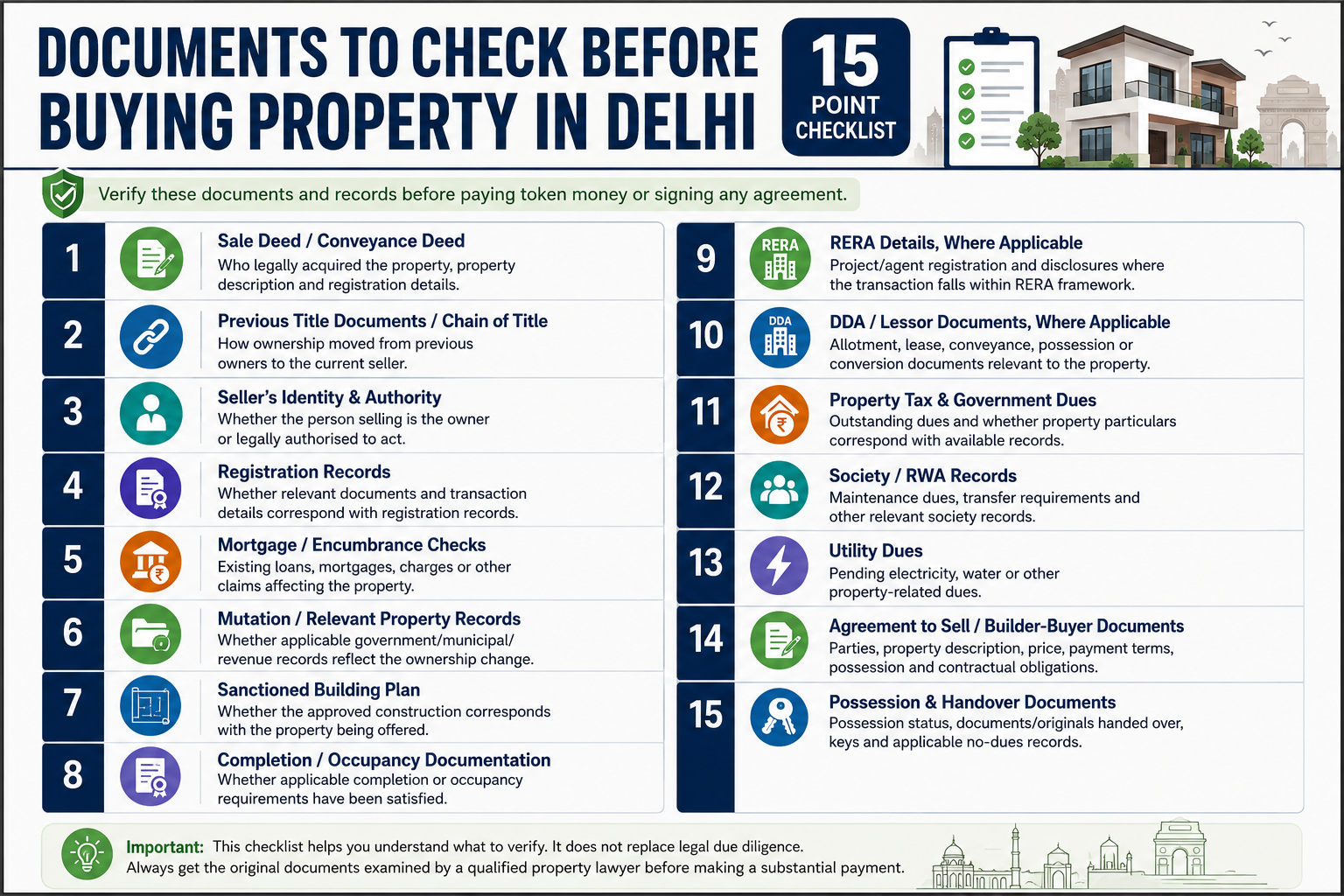
Don’t Treat This as a “15 Documents = Safe Property” Formula
This distinction will make our article better than the generic competitors. Having all 15 items on a checklist does not automatically establish that a property has a clear and transferable title. The documents need to be read together.
For example, a buyer may see:
Seller’s name on electricity bill ✓
Property-tax receipt ✓
Possession of property ✓
and conclude:
“The seller owns the property, so everything is fine.”
That conclusion may be unsafe.
Delhi Revenue itself distinguishes registered instruments such as Sale/Title Deeds and Conveyance Deeds from instruments such as GPA, and its official guidance notes that registration and title issues must be understood according to the actual instrument involved.
This is why our next step is not merely asking:
“Does the seller have the document?”
Instead, ask:
“What rights does this document establish, does it relate to this exact property, is it consistent with the other documents, and can the seller legally transfer those rights to me?”
CredEstate Buyer Rule: A property document checklist tells you what to investigate. It does not replace a proper title and legal due-diligence exercise.
One useful Delhi-specific advantage
Delhi buyers can independently investigate more than many people realise.
The Delhi Revenue Department currently provides facilities/resources for searching past property registrations, deed records, prohibited-property information and encumbrance-related checks. Its current property-registration guidance also directs registration to the Sub-Registrar office having jurisdiction over the property.
Delhi Revenue Department — Property Registration
Later in this guide, we’ll show where to verify each major document rather than simply telling you to “verify it.”
Buying your first home? Read our पहली बार घर कैसे खरीदें guide before paying token money to understand budgeting, property selection, home loans and the overall buying process.
1. Sale Deed or Conveyance Deed: Start With the Ownership Document
Among the documents to check before buying property in Delhi, the registered Sale Deed or applicable Conveyance Deed is one of the first documents a buyer should examine. A Sale Deed records the transfer of rights in the property from the seller to the purchaser through a sale transaction. Delhi’s Revenue Department lists Sale Deeds among the documents handled through property registration and states that property documents are registered through the Sub-Registrar having jurisdiction over the property.
A Conveyance Deed may arise in different circumstances—for example, Delhi Revenue separately discusses conveyance documentation in connection with conversion of leasehold property into freehold.
The important point for a buyer is not simply:
“Does the seller have a Sale Deed?”
The real question is:
“Does this document actually relate to the property I am buying, does it establish the seller’s claimed rights, and is it consistent with the rest of the ownership chain?”
What Should You Check in the Sale Deed?
Don’t stop after seeing a stamp or registration number. Examine the document carefully and compare it with the property being offered.
Check:
Seller’s name and details — Do they correspond with the person claiming to sell the property?
Buyer’s name in the previous transaction — If your seller acquired the property through this deed, is the seller correctly identified as the purchaser/transferee?
Property description — Check the address, plot/flat/floor number, area, boundaries and other identifying particulars appearing in the document.
Ownership/share described — Determine what interest or share the document actually records.
Registration particulars — Check the registration details and relevant Sub-Registrar information.
Execution and registration dates — Make sure the chronology makes sense when compared with earlier and subsequent documents.
Consideration mentioned in the deed — Review the consideration recorded in the previous transaction where relevant to your due diligence.
Rights and restrictions — Read the document for rights, reservations, restrictions or other provisions affecting the property.
Previous-title references — Where the deed refers to earlier ownership documents, those references should be followed rather than treating the latest deed as the entire history.
Sale Deed Red Flags
Investigate further if:
- The seller’s identity does not correspond with the ownership document.
- The property description differs materially from the property being shown.
- Floor, plot, area or other identifying details are inconsistent across documents.
- A link in the previous ownership chain cannot be explained.
- The seller refuses to show the original document or provide a reasonable explanation for its absence.
- Names or ownership shares differ across documents without supporting documentation.
- The seller claims rights such as exclusive parking, terrace rights or additional areas that are not supported by the relevant documentation.
- The property is being sold through a representative but the representative’s authority has not been independently examined.
CredEstate Red Flag: Never assume that a document belongs to the property simply because the address looks similar. Match the property’s identifying details across the complete document set.
Sale Deed vs GPA: Don’t Treat Them as the Same Thing
This deserves special attention in Delhi.
A General Power of Attorney (GPA) can authorise another person to perform specified acts on someone’s behalf. It should not automatically be treated as equivalent to a registered conveyance transferring ownership.
Delhi Revenue’s published guidance discussing the Supreme Court’s Suraj Lamp decision states that GPA/Agreement to Sell/Will arrangements, separately or collectively, are not recognised as a valid mode of transferring title merely by themselves, while genuine powers of attorney may still be used for legitimate purposes such as authorising someone to execute a conveyance.
Therefore, if someone tells you:
“Registry isn’t required; I have GPA papers.”
don’t make the purchase decision based on that statement alone.
The property’s complete documentation and transaction history should be independently examined.
This topic is large enough that we’ll later create a dedicated CredEstate guide:
GPA Property in Delhi: Is It Safe to Buy in 2026?
That will become another internal link in this article once published.
How Can You Check Registration Records in Delhi?
This is where we can make our article more actionable than many competitors.
The Delhi Revenue Department states that past property-registration details can be searched online without a search fee and currently provides resources including:
- e-Search for registration records
- DORIS deed-document search
- Encumbrance search
- Prohibited-property search
- Registration records for different historical periods
So instead of relying only on the photocopy supplied by the seller or broker, buyers can use the available official registration resources as part of their verification process.
Delhi Revenue — Property Registration & Official Searches
Important: Finding a registered document in government records is useful verification, but registration by itself should not be treated as a government guarantee that every possible title, construction, possession or third-party-right issue has been cleared. Property due diligence should consider the complete chain and circumstances of the transaction.
2. Previous Title Documents and Chain of Ownership
Checking the current seller’s Sale Deed is important, but it should not automatically be treated as the complete history of the property. A property may have changed hands several times through sale, gift, inheritance, partition, relinquishment, conveyance or other legally relevant transactions.
For example:
Original Owner → Buyer A → Buyer B → Current Seller → You
The documents connecting these transactions form what buyers commonly refer to as the chain of title or chain of ownership. Your objective is to understand whether there is a clear and explainable path showing how the current seller acquired the rights they now propose to transfer to you.
What Should You Check in the Property’s Title Chain?
Start with the current seller’s ownership document and work backwards through the available relevant records.
Check whether:
Names connect correctly — The purchaser/transferee in one relevant transaction should logically correspond with the person transferring rights in the next, subject to events such as inheritance or other documented transfers.
Property descriptions remain consistent — Compare the property number, floor/flat/plot details, area, locality, boundaries and other identifiers.
Ownership shares are explained — If the property was jointly owned, determine how the current seller obtained the share they claim to own.
Dates make chronological sense — A transaction should fit logically into the property’s documented ownership history.
Referenced documents exist — If a Sale Deed refers to an earlier deed or conveyance, don’t ignore that reference.
Changes in property description are explainable — Changes in municipal numbers, subdivisions, floor descriptions or area should be supported by appropriate records rather than assumed to refer to the same property.
The method of acquisition is understood — Buying from someone who purchased the property can involve different supporting documentation from buying property acquired through inheritance, gift, partition or another route.
Delhi Revenue’s current registration guidance expressly recognises several different property-related instruments, including Sale Deeds, Conveyance Deeds and Gift Deeds.
What If One Link in the Ownership Chain Is Missing?
Suppose the documents show:
A → B → ? → D → Current Seller
Don’t simply accept:
“That old document isn’t important.”
A missing document doesn’t automatically prove that the transaction is invalid, but it is a reason for deeper investigation before making a substantial payment.
You need to understand:
Who owned the property during that period?
How were the rights transferred?
Why is the supporting document unavailable?
Can the relevant transaction or document be independently verified?
Delhi Revenue currently provides online facilities for searching past registration details, including registration-record searches for different periods and DORIS deed-document search.
Search Delhi property registration records — Department of Revenue
This makes it possible to independently investigate parts of the property’s registered-document history rather than relying exclusively on the paperwork handed over by the seller.
CredEstate Buyer Rule: A missing link in the title chain is not something to “sort out after registration.” Understand it before committing substantial money.
What If the Seller Inherited the Property?
This is where buyers need to stop expecting every ownership chain to contain only Sale Deeds.
Suppose the registered owner dies and their legal rights pass through succession.
The current seller may therefore not have a Sale Deed showing that they “purchased” the property.
Depending on the circumstances, relevant documents may include things such as:
previous owner’s title documents, death certificate, Will where applicable, probate/letters or court orders where applicable, succession/inheritance-related documentation, relinquishment/release documentation where applicable, and relevant mutation/record updates.
The exact documentation depends on the facts and applicable succession law, so this is an area where independent legal examination is particularly important.
Most importantly:
Check whether there may be other persons with rights or claims in the property.
If three people inherited rights but only one person is attempting to sell the entire property, that’s not something a buyer should ignore merely because that person has physical possession.
What If the Property Was Received Through a Gift?
Delhi Revenue recognises Gift Deeds among property documents handled through registration and provides registration requirements for them. If the seller claims ownership through a gift, examine the relevant registered Gift Deed and how it connects with the donor’s underlying ownership.
The chain might look like:
Original Purchase → Registered Owner → Gift Deed → Current Seller
Again, the objective is continuity. The current seller’s document should not be examined in isolation from the rights of the person who transferred the property to them.
Mutation Is Useful—but Don’t Confuse It With Title
This distinction deserves to be highlighted because it can prevent a major buyer misunderstanding.
Delhi Revenue material concerning the Delhi Land Revenue Act notes that entries in revenue records are for fiscal purposes and that mutation does not itself create or extinguish title.
Therefore:
Mutation record ≠ automatic proof of clear title
Mutation can be an important supporting record and discrepancies should be investigated, but don’t replace examination of the underlying ownership documents with:
“His name is mutated, so ownership must be clear.”
We’ll cover mutation separately later in the checklist.
Title Chain Red Flags
Investigate carefully if you find:
- A missing ownership document with no satisfactory explanation.
- Seller’s name suddenly appearing without a clear acquisition route.
- Different property numbers or areas across documents.
- Unexplained differences in ownership shares.
- One joint owner attempting to sell the whole property.
- An inherited property where possible rights of other heirs haven’t been adequately addressed.
- An old mortgage, charge or transaction appearing in the chain without evidence explaining what happened afterward.
- Documents referring to another deed that the seller refuses or is unable to provide.
- Physical possession being presented as the primary proof of ownership.
- A broker or seller insisting that the historical documents “don’t matter.”
CredEstate Red Flag: The latest Sale Deed tells you who acquired rights in the latest documented sale. The title chain helps explain how those rights reached that person.
3. Seller Identity and Legal Authority to Sell
Verifying the property is only half of the due-diligence process. You also need to verify the person who is actually selling it.
Before paying token money or signing an Agreement to Sell, establish whether the seller named in the ownership documents is the same person dealing with you—or whether the person negotiating the transaction has valid authority to act on the owner’s behalf.
This becomes particularly important when the property has joint owners, inherited ownership, an NRI owner, a Power of Attorney holder, a company or another authorised representative.
What Should You Check About the Seller?
Identity details — Compare the seller’s name and relevant identification details with the ownership documents. Differences in spelling, initials or names should be understood rather than ignored.
Ownership capacity — Determine whether the seller owns the entire property or only a particular share.
Joint ownership — If two or more people own the property, establish whether all persons whose rights need to be transferred are participating appropriately in the transaction.
Authority to sell — If someone other than the owner is handling the sale, examine the document giving that person authority.
Original documents — Ask who holds the original title documents and understand why if the seller cannot produce them.
Signatures and names across documents — Material inconsistencies between documents deserve investigation.
CredEstate Buyer Rule: Don’t verify only the property. Verify the seller, the seller’s ownership and the seller’s authority to transfer what you are buying.
What If There Are Multiple Owners?
Suppose a property is owned:
50% by Owner A + 50% by Owner B
Owner A being willing to sell does not automatically mean that Owner A can transfer Owner B’s rights.
Similarly, inherited properties may have several persons with potential rights or interests.
Before proceeding, establish:
Who currently holds rights in the property?
What share does each person hold?
Who needs to execute the transaction?
Has anyone authorised another person to act on their behalf?
This is particularly important when a seller tells you:
“My brother/sister/spouse doesn’t need to come. I’ll handle everything.”
Don’t rely on the statement alone. Verify the legal basis on which one person claims authority to deal with another person’s rights.
What If a Power of Attorney Holder Is Selling the Property?
A Power of Attorney requires careful examination.
As explained earlier, a genuine Power of Attorney can be used to authorise another person to perform specified acts. But the existence of a POA does not mean you should automatically assume that the representative can perform every act relating to the property.
Check:
Who granted the Power of Attorney?
Who is the attorney/representative?
Which property does it cover?
What powers were actually granted?
Does it authorise the relevant sale/conveyance actions?
Is the document still legally operative in the circumstances of the transaction?
Do the property details correspond with the property being purchased?
Most importantly, don’t confuse:
“The seller owns through GPA”
with:
“The registered owner has authorised a representative through a valid Power of Attorney to perform specified acts.”
Those are not automatically the same legal situation.
What If the Seller Is an NRI?
An NRI-owned property can involve additional documentation, representation and tax considerations.
If an NRI owner is acting through a Power of Attorney holder in India, buyers should carefully examine the authority being relied upon and obtain professional advice regarding the transaction.
Tax treatment can also differ from an ordinary resident-to-resident property transaction, particularly regarding the buyer’s tax-deduction obligations.
For that reason, don’t apply a standard resident-seller checklist blindly to an NRI transaction.
Important: For an NRI seller transaction, obtain current professional advice on both the title documentation and applicable tax/TDS obligations before releasing substantial payment.
We should later create a dedicated article around Buying Property From an NRI in India, rather than overloading this article with tax rules.
What If the Seller Is a Company or Developer?
When the seller is not an individual, verify the entity and the authority of the person signing on its behalf.
Depending on the transaction, relevant checks may include:
entity details → authorised signatory → authority/resolution → property ownership or development rights → applicable project documentation → RERA information where applicable.
Don’t assume that someone using the developer’s letterhead or company email automatically has authority to bind the entity in a property sale.
Seller Authority Red Flags
Investigate further when:
- The person negotiating the sale is not named in the ownership documents.
- One joint owner is trying to sell the entire property without explaining the authority to act for the others.
- The seller refuses to provide adequate identity information.
- Names materially differ between ownership and identity documents.
- A POA holder cannot clearly establish the source or scope of their authority.
- The property owner is supposedly abroad, but you cannot satisfactorily establish the owner’s involvement or representative’s authority.
- Original title documents are said to be “with someone else” without a satisfactory explanation.
- The seller pressures you to pay token money before allowing proper document verification.
- The person receiving money is different from the owner without a clear documented basis.
CredEstate Red Flag: If you cannot establish who owns the property and who has authority to sell it, don’t let urgency, brokerage pressure or a “limited-time deal” replace due diligence.
4. Registration Records: Verify the Document Against Official Records
Seeing a registration stamp, document number or photocopy of a registered deed should not be the end of your verification.
When reviewing the documents to check before buying property in Delhi, buyers should compare the property documents supplied by the seller with the registration information available through the relevant official records.
The Delhi Revenue Department provides online facilities for searching historical property-registration information and deed records. Depending on the record and period involved, buyers can use these resources as part of their independent verification.
What Should You Compare With Registration Records?
When a seller provides a registered Sale Deed, Conveyance Deed, Gift Deed or another relevant registered instrument, check whether available official information corresponds with the document in your possession.
Compare:
Document/registration number — Does it correspond with the registration record?
Registration date — Does the date match?
Sub-Registrar Office — Was the document registered with the relevant registration office?
Names of parties — Do the names appearing in the available record correspond with the parties shown in the document?
Property particulars — Where available, compare identifying details with the property being purchased.
Type of registered document — Understand what was actually registered. A registered document should not automatically be assumed to be a Sale Deed merely because someone refers to it as a “registry.”
Previous registration references — Where the current deed refers to earlier registered instruments, those references can help you investigate the ownership chain.
CredEstate Buyer Rule: Don’t ask only, “Is something registered?” Ask, “What document is registered, between whom, for which property and what rights does it record or transfer?”
“Registry Hai” Is Not Enough
In property conversations, buyers often hear:
“Property ki registry hai, tension ki koi baat nahi.”
That statement oversimplifies property due diligence.
Registration can establish that a particular document was formally registered, but buyers still need to examine the nature of that document, ownership history, seller’s authority, property description, mortgages or other claims, applicable approvals and other relevant records.
A registration entry should therefore form part of your verification—not replace it.
How to Search Delhi Property Registration Records
Delhi Revenue currently provides access to property-registration resources including searches for past registration details and deed documents. Use the official government facility rather than relying exclusively on screenshots or search results supplied by a seller or broker.
Delhi Revenue Department — Property Registration
Where an online search does not provide enough information for the particular transaction, buyers may need further record/document verification and professional legal assistance.
Registration Record Red Flags
Investigate further if:
- The registration number provided cannot be satisfactorily matched with the relevant records.
- Names appearing in the supplied document materially differ from the available registration information.
- The seller describes one type of document while the record indicates another.
- Registration dates or document references are inconsistent.
- Property particulars differ materially across the documents.
- A seller refuses to allow reasonable verification of the registered document.
- The seller repeatedly says “registry is enough” when you ask about the previous title chain or other property documentation.
CredEstate Red Flag: Registration is an important piece of the puzzle. It is not the entire property due-diligence process.
5. Mortgage, Home Loan, Encumbrance and Third-Party Claims
A property can have genuine ownership documents and still carry a mortgage, outstanding home loan, charge, court dispute or another third-party claim.
That is why mortgage and encumbrance verification is among the most important documents to check before buying property in Delhi—particularly for resale properties.
Suppose the seller purchased a property for ₹80 lakh using a home loan and still owes ₹25 lakh to the bank.
The seller may genuinely own the property, but the buyer still needs to understand:
What interest does the lender have in the property, how will the outstanding loan be cleared, and how will the necessary original documents or lender-related documentation be released?
Don’t leave that question until after you’ve paid the seller.
How Do You Know Whether a Property Has an Existing Home Loan?
Ask the seller directly whether the property is currently financed or has previously been mortgaged.
Where a loan exists, relevant verification may include:
Lender details — Which bank or financial institution financed the property?
Outstanding loan amount — What amount remains payable?
Original property documents — Are original title documents currently held by the lender?
Loan account information — Does the information correspond with the seller and property?
Foreclosure/closure process — How will the existing loan be repaid as part of the transaction?
Lender documentation — What confirmation, release, NOC or other documentation will be issued once the relevant liability is discharged?
Document release — When and how will original documents held by the lender be released?
The exact process can vary by lender and transaction structure, so don’t assume every resale involving a home loan will follow exactly the same sequence.
A Home Loan Does Not Automatically Mean “Don’t Buy”
An existing mortgage does not automatically make a property unsuitable for purchase.
Many resale properties are sold while a housing loan is still outstanding.
What matters is that the buyer understands and appropriately documents:
existing liability → repayment mechanism → lender involvement → release/discharge → transfer to buyer
The dangerous situation is not simply:
“Seller has a loan.”
It is:
“Nobody has properly verified the loan, outstanding amount or how the lender’s interest will be dealt with before the buyer pays.”
Don’t Pay the Entire Amount Directly to the Seller Without Understanding the Loan Closure
Imagine:
Agreed property price: ₹1 crore
Seller’s outstanding home loan: ₹30 lakh
A buyer should not simply transfer ₹1 crore to the seller and expect the seller to “close the loan later.”
The transaction may need to be structured so the existing liability is discharged appropriately and the lender’s interest/document custody is dealt with as part of the sale.
If you are financing your purchase through another bank, your lender’s legal and banking teams may also become involved in the process.
CredEstate Buyer Rule: When a property has an outstanding loan, understand the money flow and document-release flow before transferring substantial funds.
What Does “Encumbrance” Mean?
In simple terms, an encumbrance can refer to a claim, liability, charge or restriction affecting the property or the owner’s ability to transfer it freely.
Depending on the circumstances, concerns may include:
mortgages or loans
previous sale/gift transactions
court orders or injunctions
certain disputes or claims
other registered or legally relevant burdens affecting the property
Delhi Revenue’s current property-registration information does something useful here: its guidance on checking non-encumbrance does not tell buyers to rely on one document alone. It identifies multiple areas for checking, including property-tax/utilities and DDA e-mutation, banks, Revenue Court matters, and judicial cases in the Supreme Court, High Court and District Courts.
That reinforces an important point:
Property due diligence is a multi-source investigation, not a single-certificate exercise.
Does Delhi Have a Non-Encumbrance Certificate?
Yes, but we need to explain this carefully because generic property blogs often oversimplify it.
Delhi Revenue currently publishes a process for obtaining a Non-Encumbrance Certificate through the office of the Sub-Divisional Magistrate having jurisdiction over the property. The published process includes ownership evidence, affidavits and a report involving the relevant Sub-Registrar records.
Delhi Revenue — Non-Encumbrance Certificate
However, don’t interpret a single search or certificate as a substitute for broader legal due diligence where the transaction warrants it.
For example, Delhi Revenue’s own current guidance separately points users toward banks and court-case checks when examining non-encumbrance.
This is exactly why we avoided copying the generic advice:
“Just obtain an EC and you’re safe.”
What If the Seller Says the Loan Has Already Been Closed?
Don’t stop at:
“Loan khatam ho gaya hai.”
Ask for the relevant supporting documentation and understand whether the lender has completed the applicable closure/release process.
Check, as applicable:
loan closure evidence
lender NOC/release documentation
return of original title documents
whether any mortgage/charge-related record requires satisfaction/release
whether the documents returned by the lender are complete
Also compare the originals received from the lender against the property’s title-document chain.
What About Court Cases and Property Disputes?
A buyer should also investigate whether the property or seller’s claimed rights are affected by relevant litigation.
Delhi Revenue’s current non-encumbrance guidance expressly directs users to check Revenue Courts and judicial cases in the Supreme Court, High Court and District Court as part of its broader non-encumbrance information.
This becomes especially important where:
- Family members dispute inherited property.
- Ownership or partition is contested.
- A court has restricted transfer of the property.
- The property is involved in a pending title dispute.
- Someone other than the seller claims rights in the property.
A seller simply declaring:
“There is no case on the property.”
is not the same thing as independent verification.
Mortgage & Encumbrance Red Flags
Investigate further if:
- The seller initially denies having a loan but original documents are held by a bank.
- The seller refuses to disclose lender details.
- Outstanding loan figures are unclear or keep changing.
- The seller wants the entire consideration before dealing with the lender.
- Original title documents cannot be accounted for.
- An old mortgage appears in the property’s records without a satisfactory explanation of its discharge.
- There is an unresolved court dispute involving ownership or transfer.
- The seller insists that one online search proves the property is completely free from every possible claim.
- A third party claims ownership, possession or another interest in the property.
- The seller pressures you to ignore a discrepancy because registration is scheduled soon.
CredEstate Red Flag: A clean-looking Sale Deed does not automatically tell you whether the property is currently mortgaged, disputed or affected by another claim.
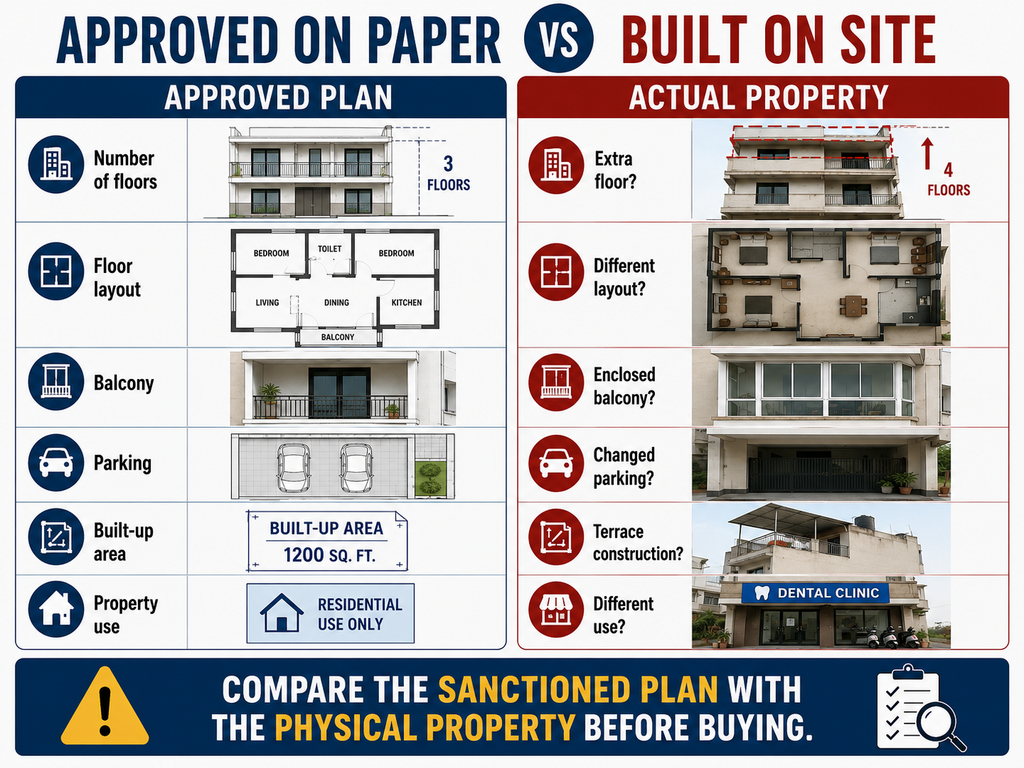
6. Sanctioned Building Plan: Check What Was Approved vs What Was Actually Built
A property’s ownership documents can appear satisfactory while the physical construction itself does not correspond with the approved building plan.
This is especially important when buying a builder floor in Delhi, where buyers may be attracted by an additional room, extended balcony, terrace access, extra covered area, parking arrangement or other modification.
Before purchasing, understand:
What construction was officially sanctioned, and does the property being sold substantially correspond with that approval?
A sanctioned building plan generally shows the construction approved by the relevant authority according to the applicable building rules and property circumstances.
Simply seeing a completed building does not establish that every part of that construction was approved.
What Should You Check in the Sanctioned Building Plan?
Where applicable to the property, compare the approved plan with what actually exists on site.
Check:
Plot and property details — Do the identifying details correspond with the property you are considering?
Number of floors — Does the physical building contain floors or structures that are not reflected in the relevant approved plan?
Floor layout — Compare the sanctioned layout with the actual floor being sold.
Built-up areas — Investigate material differences between the approved construction and what exists physically.
Balconies and extensions — Check whether significant extensions or enclosed areas differ from the sanctioned configuration.
Stilt and parking areas — Understand what the approved plan shows and what rights are actually being represented to you.
Terrace/roof areas — Don’t assume physical access to a terrace automatically establishes exclusive legal rights over it.
Property use — Understand the sanctioned/permitted use relevant to the property rather than relying only on how the premises are currently being used.
CredEstate Buyer Rule: Don’t compare property documents only with other documents. At some point, compare the documents with the actual property.
A Common Builder-Floor Situation
Imagine you visit a builder floor in Delhi and the seller says:
“This extra room was added later. Everybody in this area has done it.”
That statement doesn’t answer the buyer’s actual question.
You need to determine whether the additional construction is authorised, regularised where legally applicable, or otherwise creates a potential issue.
Similarly:
“The builder gave us this terrace.”
or
“This parking belongs only to this floor.”
should not be accepted solely as verbal assurances.
Check what the relevant title documents, sanctioned documentation and other applicable property records actually support.
Builder Floor Buyers Should Be Particularly Careful
We’ve already discussed the lifestyle and ownership differences between builder floors and apartments in our existing guide:
Builder Floor vs Apartment in Delhi: Which Is Better for Buyers in 2026?
This is the perfect internal-link location.
Add a sentence:
Considering a builder floor? Read our Builder Floor vs Apartment in Delhi comparison to understand privacy, maintenance, amenities, ownership and other differences before choosing between the two.
Link Builder Floor vs Apartment in Delhi to your existing article.
This gives us a highly contextual internal link rather than adding links randomly for Rank Math.
Sanctioned Plan vs Sale Deed: They Answer Different Questions
This distinction can help us target another search/snippet opportunity.
| Document | Primarily Helps You Investigate |
|---|---|
| Sale/Conveyance Deed | Ownership/transfer and property description |
| Sanctioned Building Plan | Approved construction/layout |
| Completion Documentation | Applicable completion requirements |
| Occupancy Documentation | Applicable permission/status concerning occupation/use |
| Physical Inspection | What actually exists at the property |
Therefore:
Registered ownership documentation does not, by itself, establish that every part of the physical construction is sanctioned.
That is why buyers should examine title + approvals + actual construction together.
Sanctioned Building Plan Red Flags
Investigate further when:
- The seller refuses to show applicable sanctioned building documentation.
- The physical number of floors differs from the approved documentation.
- A large extension appears to have been added later.
- The seller describes an area as “approved” but cannot support the claim.
- Property area/layout differs materially across documents.
- Parking rights are promised verbally but aren’t supported by relevant documents.
- Exclusive terrace rights are claimed without appropriate documentary support.
- The seller repeatedly says “everyone in the locality has done it” instead of explaining the property’s approval status.
- You’re pressured to ignore deviations because a bank is supposedly willing to finance the property.
CredEstate Red Flag: A beautiful renovation can hide a documentation problem. Verify whether important structural additions or modifications correspond with the applicable approvals.
7. Completion Certificate and Occupancy Certificate: What Should Delhi Buyers Check?
After checking whether the construction corresponds with the sanctioned building plan, the next question is whether the property has the applicable completion and occupancy-related documentation.
You may commonly hear two terms during a property transaction:
Completion Certificate (CC) and Occupancy Certificate (OC).
They are related to the building’s approval/completion process, but they should not simply be treated as interchangeable documents.
More importantly, the documentation applicable to a particular Delhi property can depend on factors such as the property type, building, age, approving authority and circumstances of construction.
Therefore, a buyer should not blindly apply the documentation checklist of a new apartment project to an older builder floor or another category of property.
CredEstate Buyer Rule: Ask which completion and occupancy documentation is applicable to this specific property, and then verify its status instead of assuming “OC is not required here” because the seller says so.
What Is a Completion Certificate?
In practical terms, completion-related certification/documentation concerns whether construction has been completed in accordance with applicable sanctioned plans and regulatory requirements.
For a buyer, the important questions are:
Was a sanctioned building plan issued?
Was completion subsequently reported/approved as required?
Does the completed building materially correspond with the approved construction?
Were significant deviations or additions made afterward?
The certificate itself should therefore not be examined in isolation from the sanctioned plan and actual property.
What Is an Occupancy Certificate?
An Occupancy Certificate generally concerns the building’s approval/status for occupation following the applicable completion and regulatory process.
For buyers, particularly those considering a newer apartment or project, this can be an important due-diligence document.
However, don’t turn the question into:
“Seller showed me an OC, so the property is legally perfect.”
An OC does not replace verification of:
ownership/title → seller authority → mortgages → property description → RERA where applicable → dues → other transaction-specific documentation.
Similarly, absence of an OC should not be casually dismissed without first understanding whether one was applicable and what the property’s actual approval status is.
What Should You Check in an OC or Completion Document?
Where these documents are applicable, examine:
Property/project identification — Does the certificate relate to the building or project containing the property you’re purchasing?
Issuing authority — Which competent authority issued the document?
Certificate/reference number — Is there sufficient information to independently verify it where verification is available?
Date of issuance — Does the timing correspond logically with the construction/project history?
Building/floor coverage — Understand whether the document applies to the relevant building, block, phase or portion.
Conditions or limitations — Read the document rather than relying only on its heading.
Consistency with sanctioned plan — Compare the certification with the building approval documentation.
Later modifications — Determine whether substantial construction was added after the relevant approval/certification.
Important: A certificate relating to an entire project or building should not automatically be interpreted as approval of every later alteration inside an individual property.
“People Have Been Living Here for Years” Is Not Documentation
A seller may say:
“Families have lived here for ten years, so there cannot be any approval problem.”
Long-term physical occupation may be relevant context, but it is not a substitute for checking applicable property documentation.
Similarly:
Electricity connection ≠ automatically clear title
Property-tax payment ≠ automatically sanctioned construction
Physical possession ≠ automatically transferable ownership
People occupying the building ≠ automatically complete regulatory verification
This follows the same principle we established earlier in the article: different records answer different questions about a property.
What About Resale Apartments?
When buying a resale apartment, don’t assume that because the first owner purchased directly from a developer, all project documentation is automatically in order.
Depending on the property and project, investigate relevant documents such as:
applicable completion/occupancy documentation
original allotment or builder-buyer documentation
conveyance/title documentation
society/RWA records
maintenance/no-dues status
RERA information where applicable
subsequent resale documents
This becomes particularly important when the apartment has changed owners multiple times.
OC and Completion Documentation Red Flags
Investigate further if:
- The seller cannot explain whether completion/occupancy documentation applies to the property.
- A certificate shown belongs to a different block, phase or building.
- Important identifying details don’t correspond with the property.
- Significant construction appears to have been added after certification.
- The seller says an OC “doesn’t matter” without explaining the property’s regulatory position.
- A photocopy or screenshot is shown but reasonable verification is discouraged.
- The sanctioned plan and actual construction materially differ.
- The broker uses electricity, water or property-tax records as proof that construction approval must be complete.
CredEstate Red Flag: Occupation of a property and approval of a property are not automatically the same thing.
8. RERA Verification: Check the Project Before Buying Property in Delhi
When buying a property in a new or under-construction real-estate project, RERA verification can be an important part of property due diligence.
The Real Estate (Regulation and Development) framework requires registration for projects falling within its scope, subject to statutory exemptions and the circumstances of the particular project. Therefore, don’t assume that every resale flat, builder floor or older property in Delhi must have a RERA registration number.
Instead, ask:
“Is this project required to be registered under RERA, and if so, does the information being given to me match the information available with Delhi RERA?”
Delhi RERA registration certificates also state that registered real-estate agents must not facilitate sales in projects that are required to be registered but are not registered with the Authority.
What Should You Check on Delhi RERA?
Where RERA applies to the project, don’t simply look for a registration number.
Check the available project information for:
Project name — Does it correspond with the development being marketed to you?
Promoter/developer — Is the promoter shown in the RERA information the same entity represented to you?
RERA registration number — Compare it with advertisements, brochures and documents supplied by the developer or agent.
Project location and details — Make sure you’re checking the correct project rather than another development with a similar name.
Registration/status information — Review the current information displayed for the project.
Declared completion timeline — Compare relevant disclosed timelines with what the salesperson is promising.
Approvals and disclosures — Examine available project documents and information rather than relying solely on the sales brochure.
Updates — For an under-construction project, check available progress/status information.
Orders/complaints where relevant — If material disputes or regulatory proceedings appear, understand what they concern before making a substantial commitment.
Use the official portal:
Delhi Real Estate Regulatory Authority (RERA)
Don’t Verify RERA Using Only a Brochure or WhatsApp Screenshot
Suppose a salesperson sends you:
RERA Registration No: XXXXX
Don’t treat the presence of the number itself as verification.
Search the project through the official authority and compare the information.
A number could potentially be:
- typed incorrectly,
- associated with another project,
- shown without relevant context,
- outdated in some respect,
- or presented alongside marketing claims that go beyond what the official records disclose.
CredEstate Buyer Rule: When an official verification source exists, independently check it rather than relying solely on material supplied by the person selling the property.
RERA Registration Does Not Replace Property Due Diligence
This is an important distinction.
Suppose you confirm:
RERA registration ✓
That doesn’t mean you should stop checking everything else.
You may still need to investigate:
your agreement and payment terms
title/ownership documentation
mortgages or charges
sanctioned building plans
applicable completion/occupancy documentation
property specifications
possession terms
seller/promoter authority
other transaction-specific risks
Think of RERA verification as one layer of due diligence, not a universal certificate declaring:
“This property has zero legal or financial risk.”
What If You’re Buying a Resale Flat?
This is where many generic checklists become confusing.
If you’re buying an older completed flat from an existing owner, your transaction may require much greater emphasis on:
the seller’s title → chain of ownership → mortgage status → conveyance documents → society/RWA records → dues → physical property → applicable approvals.
Don’t mechanically reject an older resale property simply because someone tells you:
“I can’t find its RERA number.”
First determine whether RERA registration is actually applicable to the relevant project and circumstances.
What About the Real-Estate Agent?
RERA verification isn’t limited to projects.
Delhi RERA also registers real-estate agents. Official Delhi RERA agent certificates state that registered agents are subject to conditions including compliance with the Act and facilitating information/documents to which an allottee is entitled.
This is particularly relevant for CredEstate because your platform includes agent registration.
Eventually, your agent-profile pages could include fields such as:
RERA Registration Number
Registration Status
Registration/renewal details
Verification date
But CredEstate should only display a “Verified” badge if your system actually performs a defined verification rather than merely allowing an agent to type a registration number.
RERA Red Flags
Investigate further when:
- A project that appears to require registration is marketed without satisfactory RERA information.
- The salesperson refuses to provide the project’s registration details.
- The number shown in marketing material doesn’t correspond with the project you are investigating.
- Developer/promoter information materially differs from what you’re being told.
- Major promises made by the salesperson cannot be reconciled with available project information or contractual documentation.
- You’re told that RERA registration means “no other legal verification is necessary.”
- Someone asks you to rely on a screenshot rather than checking the official source.
CredEstate Red Flag: RERA registered and fully verified property are not interchangeable statements.
SEO/internal-link opportunity
Later, once your portal has individual project pages, this section can internally link:
RERA-registered projects in Delhi → project page → available properties → agent → locality page.
That is much stronger SEO architecture for CredEstate than treating the website as a standalone blog.
9. DDA Property Documents: What Should You Verify Before Buying a DDA Flat?
Buying a DDA flat or another DDA-allotted residential property in Delhi can involve a different documentation trail from buying a privately developed apartment or builder floor.
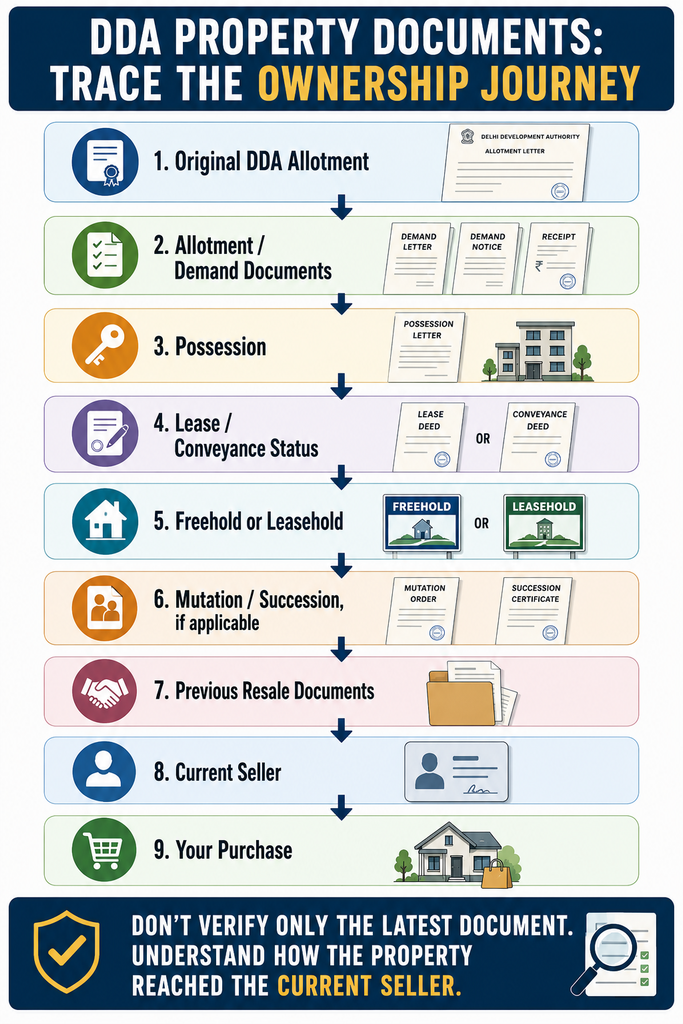
Depending on the property’s history and status, the documentation may involve stages such as:
Allotment → Payment/Demand Records → Possession → Lease/Conveyance Documentation → Mutation or Substitution → Freehold/Leasehold Status → Subsequent Resale Documents
Not every DDA property will have exactly the same document history. An original allottee selling a recently acquired property can present a very different documentation trail from a DDA flat that has changed owners several times.
Therefore, don’t simply ask:
“Is this a DDA flat?”
Ask:
“How did the current seller acquire rights in this particular DDA property, what is its present tenure/status, and which DDA and registered documents support that history?”
DDA’s current Housing Manual itself provides separate resources for mutation, leasehold-to-freehold conversion and execution of conveyance deeds, demonstrating why these documents need to be understood according to the property’s particular history.
What Documents Should You Check for a DDA Property?
Depending on the property and its history, investigate the applicable documents and records, including:
Allotment documentation — Establish to whom the property was originally allotted and under which applicable scheme.
Demand/payment documentation — Examine relevant payment/demand records where they form part of the property’s allotment history.
Possession Letter — Understand when and to whom possession was formally delivered.
Lease documentation, where applicable — If the property remains leasehold, examine the applicable lease documentation and conditions.
Conveyance Deed, where applicable — Where the property has been conveyed/freehold rights documented, examine the relevant conveyance documentation and registration.
Mutation/substitution records, where applicable — Check subsequent changes recorded with DDA, particularly where ownership history involves death/inheritance or another recognised transfer circumstance.
Leasehold-to-freehold documentation, where applicable — If the seller claims that the property was converted to freehold, verify the applicable conversion/conveyance records rather than relying only on the seller’s statement.
Subsequent Sale Deeds or other title documents — If the property has subsequently been sold, trace the later ownership chain through the appropriate registered documentation.
Mortgage/lender documentation — Determine whether the property is or was financed and whether relevant lender interests have been properly dealt with.
Outstanding DDA dues or other applicable liabilities — Investigate dues relevant to the particular property and transaction.
Important: The document set should be determined by the property’s actual history. Don’t demand a random internet checklist without understanding whether each document applies.
Allotment Letter Is Not the Same as Conveyance Deed
This distinction is particularly important.
An allotment document can establish important information concerning the original allotment of a DDA property.
But don’t automatically treat:
Allotment Letter = final registered ownership/conveyance document
as a universal rule.
For example, DDA’s 2026 housing documentation states that its Conveyance Deed transfers title to the flat and is registered with the Sub-Registrar. Its current scheme documentation also connects execution of the Conveyance Deed with possession and completion of applicable formalities.
For a resale buyer, the objective is therefore to understand the entire progression of rights, not merely to see the original allotment letter.
Check Whether the DDA Property Is Freehold or Leasehold
This deserves special attention because buyers frequently hear:
“DDA flat hai, freehold hai.”
Don’t rely on that statement alone.
Ask for the documentation supporting the property’s current status.
DDA currently provides online services relating to registration/allotment, freehold queries and mutation status, while its Land Disposal services also include e-conversion and e-mutation facilities for applicable properties.
If the property is represented as having been converted from leasehold to freehold, examine the relevant conversion and conveyance documentation.
If it remains leasehold, understand the applicable lease conditions and transaction implications before purchasing.
Internal-link opportunity
This is where our next article will fit perfectly:
Freehold vs Leasehold Property in Delhi: Which Is Better for Buyers in 2026?
Once that article is published, internally link the words freehold vs leasehold property in Delhi from this section.
What If the Original DDA Allottee Has Died?
This situation needs additional care.
Suppose:
DDA allotted property to Mr. A → Mr. A died → family member B is now selling
Don’t simply assume B has the complete transferable rights because B:
- lives in the property,
- pays maintenance,
- possesses the original papers,
- or has their name appearing in some subsequent record.
The succession and applicable DDA mutation/substitution history should be examined.
DDA’s mutation handbook provides specific procedures and documentation for mutation following death, including documentation concerning legal heirs and, where relevant, mortgage-related clearance.
For the buyer, the important question remains:
How did the rights move from the original allottee to the person now selling the property?
That history should connect with the title-chain checks we covered earlier.
Mutation Is Still Not a Substitute for Title Verification
If the seller shows you a DDA mutation record, don’t conclude:
“Mutation ho gaya, therefore title is automatically clear.”
Mutation can be an important part of the documentary history, but it should be examined together with the underlying allotment, succession, conveyance and subsequent transfer documents relevant to the particular property.
This is consistent with the principle we’ve already established earlier in this guide:
Supporting government records and title documents answer different questions.
What If Original DDA Documents Are Missing?
Don’t casually accept:
“Purane papers kho gaye.”
DDA itself publishes procedures for situations involving lost original documents. Its current Housing FAQ, for example, identifies procedures/documentation concerning loss of certain original allotment/registration records.
Therefore, if important original documents are missing:
Ask exactly which documents are missing.
Ask why and when they went missing.
Examine the applicable loss/reconstruction procedure.
Check whether any FIR, public notice, affidavit, indemnity or other applicable documentation exists.
Investigate whether the originals could instead be held by a lender or another person.
Missing originals don’t automatically establish fraud, but they are something to investigate before payment, not after registration.
DDA Property Red Flags
Investigate further if:
- The seller cannot establish how they acquired rights from the original allottee.
- The seller claims the property is freehold but cannot support that status with appropriate documentation.
- Original allotment, conveyance or important title documents are missing without a satisfactory explanation.
- The seller’s name differs from DDA/title records without a documented transfer, mutation or succession explanation.
- An inherited DDA property is being sold without adequately addressing other persons who may hold rights.
- The property is mortgaged but the seller cannot explain the lender/document-release process.
- The seller shows only an allotment letter while avoiding questions about later conveyance or ownership history.
- Important DDA dues or liabilities remain unclear.
- Material alterations to the flat raise separate approval/documentation questions.
- The broker says “DDA property hai, legal check ki zarurat nahi hai.”
CredEstate Red Flag: DDA being associated with the original allotment does not eliminate the need to verify the current seller, current title, subsequent transfers, mortgage status, dues and physical property.
Official verification resource
For readers, add this contextual external link:
DDA Housing Services & Property Resources
DDA currently provides housing-related resources for allotment/freehold queries, mutation status, procedures and other property documentation.




Join The Discussion