
Choosing between a builder floor vs apartment in Delhi is less about which property type is universally better and more about what you value as a buyer. Builder floors typically offer greater privacy, fewer neighbours, more independence and, in many Delhi colonies, a closer connection to underlying land value. Apartments, particularly those within organised societies, generally offer stronger shared amenities, managed maintenance, security infrastructure and community living.
The decision also changes dramatically by location. A buyer comparing homes in Greater Kailash or Defence Colony faces a very different market from someone searching in Dwarka or Rohini. Your budget, family requirements, parking needs, maintenance preference, investment horizon and the property’s legal status can therefore matter more than simply choosing “builder floor” or “apartment.”
This 2026 CredEstate guide compares both options specifically from a Delhi buyer’s perspective—including cost, privacy, ownership, maintenance, resale, rental potential, legal checks and locality-specific considerations—so you can decide which format better fits your needs.
Builder Floor vs Apartment in Delhi: Quick Comparison
| Factor | Builder Floor | Apartment |
|---|---|---|
| Privacy | Higher; usually fewer households in the building | Lower to moderate depending on the project |
| Amenities | Usually limited | Often includes lifts, security, clubhouse, gym, parks, etc. |
| Maintenance | More owner-managed | Usually managed by RWA/society/maintenance team |
| Security | Depends heavily on the individual building/locality | Typically stronger in gated societies |
| Customization | Generally greater flexibility inside the unit | Usually subject to society/building rules |
| Parking | Property-specific; verify sanctioned/allocated parking | Often designated or allotted |
| Community Living | Lower | Higher |
| Purchase Price | Highly dependent on locality, plot share and specifications | Depends on project, location and amenities |
| Land/Ownership Interest | May include proportionate rights/share as documented | Ownership structure varies by project and title documents |
| Rental Potential | Strong in established low-rise residential colonies | Strong where tenants prefer managed societies and amenities |
| Resale | Depends heavily on title, location, age and construction quality | Can benefit from project/society recognition and demand |
| Best Suited For | Privacy, independence and low-density living | Amenities, managed living, security and community |
Quick verdict: A builder floor may be better for Delhi buyers who prioritise privacy, independence and low-density living, while an apartment may suit buyers who prefer managed maintenance, security, amenities and community infrastructure. For investment, neither option is automatically superior—the location, legal status, purchase price, construction quality, rental demand and future resale potential of the individual property matter more than the property format alone.
What Is a Builder Floor in Delhi?
A builder floor in Delhi is generally a self-contained residential unit occupying an entire floor of a low-rise building constructed on an individual residential plot. Instead of purchasing one flat among dozens or hundreds of units in a large apartment complex, the buyer typically owns a particular floor in a building shared by only a small number of households.
This housing format is particularly common across Delhi’s established residential colonies, where individual plots are redeveloped into multiple independent floors. Depending on the property’s title documents and sale deed, rights relating to the underlying land, parking, terrace, staircase and other common areas can differ from one property to another. Buyers should therefore verify the actual ownership rights stated in the registered documents rather than assuming that every builder floor comes with identical land or terrace rights.
From a lifestyle perspective, builder floors appeal to buyers looking for greater privacy, lower residential density and more independence than a typical large apartment society. However, they may not provide the extensive shared amenities, centralised maintenance or security infrastructure available in many organised apartment developments.
Where Are Builder Floors Common in Delhi?
Builder floors can be found across many plotted residential neighbourhoods, particularly in areas such as Greater Kailash, Defence Colony, Saket, Malviya Nagar, Vasant Vihar, Punjabi Bagh and Rajouri Garden, although the available housing format varies significantly by colony, plot and redevelopment pattern.
What Is an Apartment in Delhi?
An apartment in Delhi is an individual residential unit within a larger multi-unit or group-housing development. Unlike a typical builder floor, where only a few households may share the building, an apartment development can contain many residential units along with shared spaces, services and facilities.
Apartment ownership should also be understood as more than simply owning the space inside the flat. The Delhi Apartment Ownership Act, 1986 provides for ownership of an individual apartment along with an undivided interest in applicable common areas and facilities, subject to the relevant deed and legal framework.
From a buyer’s perspective, apartments can therefore be attractive for people who value managed maintenance, shared amenities, organised security and community living. The trade-off is that owners may have less independence over certain alterations and common areas, and recurring society or maintenance charges can be an important part of the overall ownership cost.
Builder Floor vs Apartment in Delhi: 12 Key Differences
Purchase Price & Total Cost of Ownership
1. Purchase Price & Total Cost of Ownership
The purchase price of a builder floor vs apartment in Delhi cannot be compared using property type alone. Location, plot size, floor, age of construction, parking, specifications, ownership rights and neighbourhood demand can have a much greater impact on price.
Builder floors in established plotted colonies may command a premium where land is scarce and buyers value low-density living. The price can also vary considerably between the ground, middle and top floors depending on factors such as lift access, parking rights, terrace rights and the specific terms recorded in the property documents.
Apartments work differently. Their value is often influenced by the reputation and condition of the development, floor and tower location, amenities, security, maintenance standards, parking allocation and the overall demand for that society.
Buyers should therefore compare the total cost of ownership, not just the advertised purchase price. Consider registration-related costs, brokerage where applicable, parking charges, recurring maintenance, major repairs, common-area expenses and renovation requirements before deciding which option is actually more affordable over the long term.
2. Privacy & Independence
Privacy is one of the clearest differences between a builder floor and an apartment. A typical builder-floor building contains relatively few households, and in many cases one family occupies an entire floor. This can mean fewer shared corridors, less movement around the residence and greater day-to-day independence.
Apartments generally involve a larger number of residents sharing lifts, entrances, parking areas and other common facilities. For some buyers this means less privacy; for others, the greater level of community interaction is an advantage.
Better for privacy: Builder floor
Better for community living: Apartment
3. Amenities & Lifestyle
Apartments—particularly organised or gated developments—generally have an advantage when it comes to shared amenities. Depending on the project, these may include landscaped areas, children’s play spaces, community halls, gyms, sports facilities, power backup and centrally managed common areas.
Builder floors typically provide fewer shared lifestyle facilities because they are constructed on individual plots rather than as large residential campuses. Buyers choosing a builder floor are therefore often prioritising location, private space and independence over society-level amenities.
Better for extensive shared amenities: Apartment
Better for independent low-density living: Builder floor
4. Maintenance & Monthly Costs
Maintenance is an important part of the builder floor vs apartment decision because the way expenses are managed can be very different.
In a builder floor, there may be no large society maintenance system. Owners generally manage their own unit and share certain building-level expenses—such as lift servicing, common electricity, water systems, security or structural repairs—with the other floor owners. This can keep routine shared costs relatively limited, but a major repair may require coordination and a larger one-time contribution from a small number of owners.
Apartments usually have more structured recurring maintenance charges. These may cover security staff, lifts, landscaping, common-area electricity, housekeeping, facility management and amenities. A development with extensive facilities can therefore have a higher monthly maintenance burden, although the responsibility for managing those services is largely centralised.
Better for potentially lower routine shared costs: Builder floor
Better for professionally managed maintenance: ApartmentBuyers should ask for recent maintenance bills and information about any pending major repair or society charges before purchasing either property type.
5. Security & Access Control
Apartments, particularly gated developments, generally have an advantage in organised security infrastructure. Depending on the project, this can include controlled entry points, security personnel, visitor management, CCTV coverage and restricted access to residential towers.
Security in a builder floor is more dependent on the individual building and neighbourhood. Some premium builder floors have CCTV, video door phones, controlled gates and private security, while others rely mainly on individual security arrangements or colony-level measures.
This does not mean that every apartment is safer than every builder floor. Buyers should evaluate the actual security arrangements of the specific property rather than relying only on the property type.
Better for organised security infrastructure: Apartment
Better for individual control over home security: Builder floor
6. Parking
Parking can significantly affect both everyday convenience and the resale appeal of a Delhi property, particularly in established neighbourhoods where road space is limited.
Builder-floor parking arrangements vary considerably. A property may have stilt parking, designated spaces or another arrangement, but buyers should verify exactly what parking rights are included in the sale documents instead of relying only on what is shown during a site visit.
Apartments often have more formally managed parking arrangements, although the number of spaces, type of parking and rights attached to them vary by development. Visitor parking can also differ significantly between societies.
For either property type, buyers should verify how many parking spaces are available, whether they are specifically allotted, where they are located and what the relevant documents actually provide.
Winner: No universal winner — verify the specific property’s parking arrangement.
7. Space & Customization
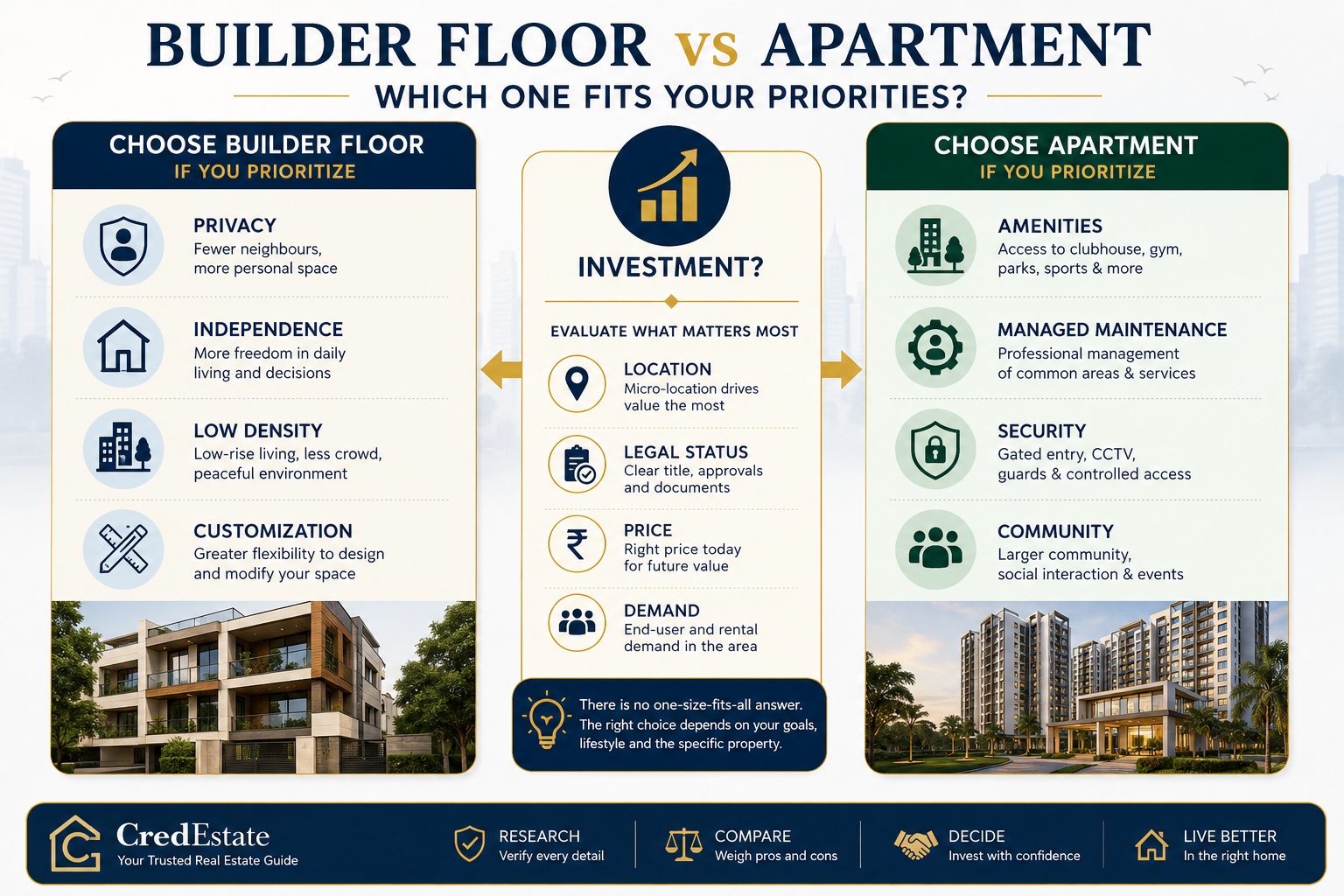
Builder floors can offer greater flexibility for buyers who want to personalise their living space. Because a floor generally functions as an independent residence within a low-rise building, owners may have more freedom over interior layouts, finishes, fixtures and renovations, subject to structural limitations, applicable building rules and the rights defined in the property documents.
Apartments can also be renovated internally, but modifications may be restricted by society rules, building management requirements and structural considerations. Changes affecting the building façade, common areas, balconies, plumbing shafts or structural elements may require additional approvals.
The actual usable space should also be compared carefully. Buyers should look beyond the advertised area and understand the property’s carpet area, built-up area and common-area allocation before comparing two homes.
Better for customization: Generally builder floor
Better for standardized, managed living: Generally apartment
8. Ownership, Land Share & Common Areas
This is an important section because many competing articles oversimplify this topic.
One common assumption is that buying a builder floor automatically means owning a fixed portion of the underlying land. In practice, buyers should rely on the registered sale deed and other applicable property documents, not assumptions made from the property format.
A builder-floor transaction may include rights or an undivided interest relating to the plot along with rights concerning common entrances, staircases, parking or terraces. However, the exact arrangement can vary significantly between properties.
Apartment ownership similarly involves an individual residential unit together with applicable rights in common areas and facilities. The exact ownership structure depends on the project’s legal documentation and the laws governing the property.
Before purchasing either type, buyers should have the documents independently reviewed and understand exactly what is exclusively owned, what is shared and what rights are attached to parking, terraces and other common areas.
Important: Never purchase a property solely because a seller verbally claims that parking, terrace or land rights are “included.” Verify those rights in the relevant documents.
Here, internally link “Delhi Apartment Ownership Act, 1986” from the previous section if appropriate; we don’t need another external link every few paragraphs.
9. Resale Liquidity
Resale potential depends much more on the individual property and micro-location than on whether the home is a builder floor or apartment.
A well-located builder floor in an established Delhi neighbourhood can attract strong end-user demand, particularly where buyers value larger layouts, privacy and low-density living. However, factors such as building age, construction quality, parking, lift availability, floor position and clarity of title can materially affect resale demand.
Apartments can benefit from the recognition of an established society or development. Buyers can often compare recent transactions within the same project, and amenities, maintenance quality and security can make the property easier for future buyers to evaluate.
For both formats, location, legal clarity, property condition and realistic pricing are more reliable indicators of resale potential than the property label alone.
Resale winner: Property-specific — there is no universal winner.
10. Rental Potential & Tenant Demand
Both builder floors and apartments can generate rental demand in Delhi, but they may appeal to different tenant profiles.
Builder floors in established residential neighbourhoods may appeal to families and professionals looking for privacy, larger living spaces and access to specific South, West or Central Delhi locations. Rental demand can be particularly location-sensitive, with proximity to business districts, schools, hospitals, markets and Metro connectivity influencing tenant interest.
Apartments may attract tenants who prioritise gated security, power backup, lifts, managed maintenance and shared amenities. Organised societies can also be convenient for tenants relocating to Delhi who prefer a more standardised residential environment.
Investors should therefore compare rental yield and occupancy potential at the micro-locality level, rather than assuming that one property format always generates better rental returns.
11. Long-Term Appreciation & Investment Potential
Neither builder floors nor apartments are guaranteed to appreciate faster. Long-term property value is influenced by factors including land scarcity, location, infrastructure, neighbourhood demand, redevelopment potential, construction quality, legal status and the price paid at purchase.
Builder floors in land-constrained established colonies may benefit from strong demand for low-density housing and the value associated with scarce residential plots. At the same time, an ageing building, poor construction or unclear documentation can reduce its attractiveness.
Apartments may benefit from organised development, better amenities and strong demand within a well-maintained society. However, a large supply of similar units, high maintenance costs or deterioration of the project can affect future resale value.
An investor should therefore ask a more useful question than “Which appreciates more?”: “Am I buying the right property, in the right micro-market, at the right price?”
That last sentence is useful enough to bold.
12. Community Living & Family Lifestyle
Apartments generally provide a stronger community environment because residents share common spaces and facilities. Children’s play areas, parks, community halls and organised activities can make apartment living attractive to families seeking regular social interaction.
Builder floors usually provide a more private residential experience. Residents may know their immediate neighbours, but there is typically less organised community infrastructure within the building itself.
The better choice depends on lifestyle. A household that values privacy and independence may prefer a builder floor, while a family looking for shared facilities, children’s activity spaces and a larger residential community may prefer an apartment.
Better for privacy-oriented living: Builder floor
Better for organised community living: Apartment
Builder Floor vs Apartment: Which Is Better by Delhi Locality?
In Delhi, the choice between a builder floor and an apartment is closely connected to where you want to live. Delhi does not have one uniform residential market. Some established colonies have a strong supply of independently developed floors on residential plots, while other parts of the city have a much larger concentration of cooperative group housing societies and apartment developments.
Buyers should therefore compare property formats within the same micro-market rather than assuming that a builder floor in one part of Delhi is directly comparable with an apartment in another.
| Delhi Locality | Common Housing Choices | What Buyers Should Consider |
|---|---|---|
| Greater Kailash | Builder floors, independent floors, some apartments | Premium location, low-density living, parking, floor position, construction quality and documentation |
| Defence Colony | Builder floors and independent residential floors | Premium pricing, plot/location quality, parking, lift, property age and ownership rights |
| Saket | Builder floors + apartments | Exact pocket/location matters; compare independent living with society amenities |
| Vasant Kunj | Apartments, society housing and some independent options | Society quality, maintenance, connectivity, parking and amenities |
| Dwarka | Apartments and cooperative/group housing | Society condition, sector, maintenance, parking, Metro access and amenities |
| Rohini | Apartments, plots and independent residential properties | Sector-specific demand, connectivity, building age and surrounding infrastructure |
| Rajouri Garden | Builder floors and independent residential properties | Location, parking, road width, commercial activity nearby and redevelopment quality |
Greater Kailash & Defence Colony: Builder Floors Deserve Serious Consideration
In established premium South Delhi neighbourhoods such as Greater Kailash and Defence Colony, builder floors form an important part of the available residential market. Buyers looking for larger layouts, fewer neighbours and a more independent style of living may therefore find builder floors particularly relevant in these locations.
However, premium locality does not remove the need for due diligence. Two floors on similarly sized plots can differ considerably because of construction quality, floor position, parking, lift access, age, road location and the rights documented in the sale deed.
For buyers considering these neighbourhoods, the question is often not simply builder floor or apartment? but which individual property offers the strongest combination of location, legal clarity, construction quality and price?
Dwarka: Apartments Become More Relevant
Dwarka presents a different residential environment. Group housing and cooperative apartment societies form a significant part of the area’s housing stock, making apartments a natural option for many buyers.
Here, comparisons may focus more heavily on the quality and age of the society, maintenance standards, lifts, parking, security, common facilities, sector location and Metro connectivity.
Buyers who value organised society living and managed common infrastructure may therefore find apartments particularly suitable in Dwarka.
Rohini: Compare Sector Before Property Type
Rohini should be evaluated sector by sector. The area contains apartments as well as plotted and independent residential development, so buyers should avoid treating the whole locality as a single property market.
Connectivity, nearby commercial infrastructure, property age, parking and the characteristics of the individual sector can all influence whether an apartment or independent-floor format makes more sense.
In markets such as Rohini, micro-location can matter as much as property type.
Builder Floor vs Apartment: Which Is Better for Different Buyers?
There is no single winner in the builder floor vs apartment in Delhi comparison. The better choice depends on why you are buying, how you intend to use the property and which compromises you are comfortable making. Here is a practical way to evaluate both options for different buyer profiles.
Which Is Better for Families?
Families who prioritise privacy, larger independent living spaces and fewer immediate neighbours may prefer a builder floor. This can be particularly attractive for larger or multi-generational households that want more control over their living environment.
Apartments may be more suitable for families that value security, children’s play areas, shared amenities, managed maintenance and a larger residential community.
Consider a builder floor if: privacy and independence are priorities.
Consider an apartment if: amenities, security and community living are priorities.
Which Is Better for Property Investors?
Investors should avoid choosing solely on the basis of property type. The stronger investment is generally the property purchased at a sensible price in a micro-market with sustainable end-user or rental demand, clear documentation and reasonable future supply.
A builder floor in a land-constrained established colony may offer a very different investment proposition from an apartment in a large development with hundreds of similar units. Conversely, a well-managed apartment in a highly demanded location may offer better rental liquidity than an expensive independent floor with a smaller tenant pool.
Investors should compare purchase price, realistic rent, vacancy risk, recurring expenses, resale demand and expected holding period before deciding.
Investment verdict: Evaluate the individual property and micro-market—not merely “builder floor vs apartment.”
Which Is Better for First-Time Homebuyers?
First-time buyers may find apartments easier to evaluate when units within the same society can be compared on price, maintenance, amenities and recent transactions. Managed common areas can also reduce some of the day-to-day responsibilities associated with maintaining a smaller independent building.
A builder floor can still be an excellent first home, but buyers should pay particular attention to documentation, sanctioned construction, parking rights, common areas, building condition and the responsibilities shared with other floor owners.
For a first-time buyer, legal clarity and affordability should take priority over property format.
Which Is Better for Senior Citizens?
Apartments with reliable lifts, controlled access, security personnel, power backup and nearby shared facilities can offer practical advantages for senior citizens. However, very large developments can also involve longer walking distances between the residence, parking and common facilities.
A well-designed builder floor with lift access, convenient parking and proximity to healthcare and daily necessities may offer greater privacy and easier low-density living.
Therefore, senior buyers should prioritise lift reliability, accessibility, healthcare proximity, security and daily convenience over whether the property is technically classified as a builder floor or apartment.
Which Is Better for Rental-Income Buyers?
Rental-income buyers should focus on the type of tenant a particular micro-market attracts. Professionals, families, students and corporate tenants can have very different requirements.
Apartments may appeal to tenants seeking security, power backup, maintenance and amenities, while well-located builder floors may attract tenants who value larger spaces, privacy and established neighbourhoods.
Calculate the investment using actual achievable rent after recurring costs and expected vacancy, rather than relying only on an advertised rental figure.
Builder Floor vs Apartment: Final Decision Matrix
| Your Priority | Consider First |
|---|---|
| Maximum privacy | Builder Floor |
| Fewer neighbours | Builder Floor |
| Greater independence | Builder Floor |
| Extensive amenities | Apartment |
| Managed maintenance | Apartment |
| Organised security | Apartment |
| Community environment | Apartment |
| Interior customization | Builder Floor generally |
| Senior-friendly living | Depends on accessibility |
| Rental investment | Depends on micro-market |
| Capital appreciation | Depends on property & location |
| Resale | Depends on demand & legal clarity |
1. Verify the Title and Registered Sale Deed
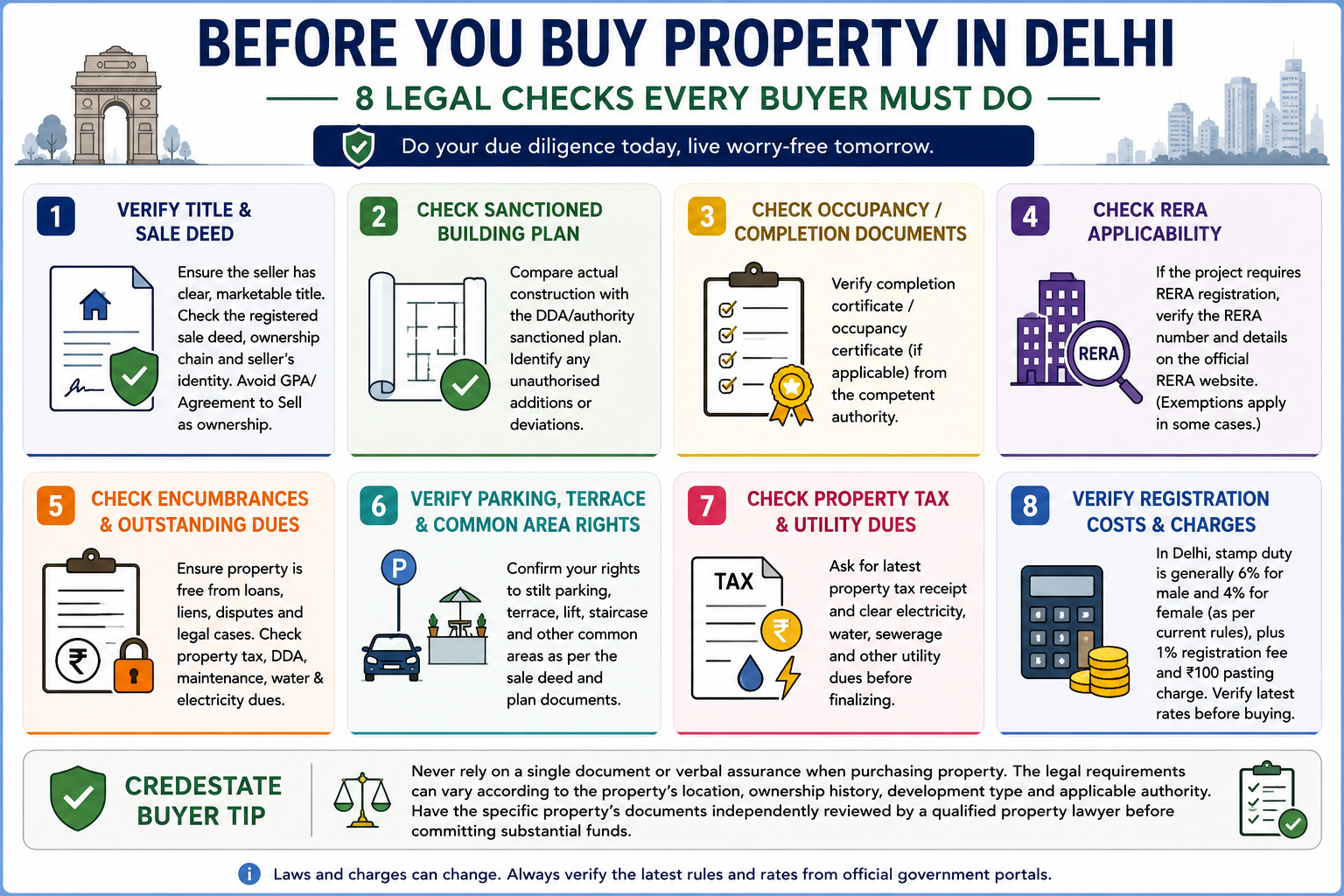
Before comparing amenities, floor plans or investment returns, verify that the seller has a legally transferable interest in the property and that the ownership chain is clear. Review the previous title documents, registered sale/conveyance deed and other relevant records with a qualified property lawyer.
Buyers should also ensure that the seller’s identity and property particulars correspond with the documents being presented.
2. Check the Sanctioned Building Plan
For a builder floor, checking the sanctioned building plan is particularly important. The actual construction should be compared with the approved plan so that buyers can identify unauthorised additions, alterations or deviations before completing the purchase.
This becomes especially important when a property has been extensively renovated, additional space has been enclosed, another floor has been constructed or the physical layout differs from the approved drawings.
3. Check Completion / Occupancy Documentation Where Applicable
Buyers should determine which completion or occupancy documentation applies to the specific building or project and verify its status with the appropriate authority.
Do not assume that a property is legally compliant simply because electricity, water, tenants or other residents are already present. Physical occupation and regulatory compliance are different questions.
4. Check RERA Registration Where Applicable
Be careful with the wording here because not every resale property or small builder-floor development is necessarily required to be RERA registered.
If the property forms part of a real estate project to which RERA registration requirements apply, buyers should verify the project’s registration and disclosed information with the relevant Real Estate Regulatory Authority.
Under Section 3 of the Real Estate (Regulation and Development) Act, a promoter generally cannot advertise, market or sell a qualifying real estate project without registration. However, the Act also contains exemptions, including certain projects not exceeding 500 square metres or eight apartments, among other situations.
Therefore, the absence of a RERA registration number should not automatically be interpreted as proof that an individual Delhi builder floor is illegal. Buyers should first determine whether RERA registration was legally required for that particular development.
5. Check Encumbrances and Outstanding Dues
Buyers should investigate whether the property is affected by an existing mortgage, financial charge, dispute or other encumbrance and whether important utility, property-tax or maintenance dues remain outstanding.
Delhi’s Revenue Department provides guidance for checking previous registration records and points buyers toward relevant sources for utility dues, property tax, DDA mutation information, bank interests and court cases when conducting non-encumbrance checks.
Delhi Revenue – Registration & Encumbrance Information
6. Verify Parking, Terrace and Common-Area Rights
For builder floors, buyers should pay particular attention to parking, terrace, staircase, lift and common-area rights. A verbal promise from a seller or broker should not replace what is actually recorded in the relevant property documents.
Apartment buyers should similarly understand their rights and obligations concerning parking and common facilities, along with applicable society or association rules.
7. Check Property Tax and Utility Dues
Ask for the latest available property-tax records and relevant electricity, water, maintenance and other utility statements. Any outstanding amount should be identified and resolved as part of the transaction process rather than discovered after possession.
8. Verify the Final Registration Costs
Buyers should budget for costs beyond the negotiated property price. Delhi’s Revenue Department currently states that for a sale deed, stamp/transfer duty is generally 6% for a male vendee and 4% for a female vendee, calculated on the applicable consideration/circle-rate basis, with a 1% registration fee plus ₹100 pasting charge. Buyers should verify the applicable rate at the time of their transaction because government rates and rules can change.
CredEstate Buyer Tip: Never rely on a single document or verbal assurance when purchasing property. The legal requirements can vary according to the property’s location, ownership history, development type and applicable authority. Have the specific property’s documents independently reviewed by a qualified property lawyer before committing substantial funds.
Builder Floor vs Apartment: Pros and Cons
| Builder Floor | Apartment | |
|---|---|---|
| Main Advantages | Privacy, fewer neighbours, independence, customization potential, low-density living | Amenities, organised security, managed maintenance, community environment |
| Main Disadvantages | Limited amenities, more owner-managed maintenance, security varies, documentation requires careful verification | Recurring maintenance costs, less privacy, society restrictions, more shared spaces |
| Best For | Buyers prioritising privacy and independence | Buyers prioritising convenience and managed living |
| Investment Strength | Can perform well in land-constrained, high-demand micro-markets | Can perform well in established, well-managed societies with strong demand |
| Main Investment Risk | Construction quality, legal/documentation issues, building age and smaller buyer pool in some markets | High supply of similar units, ageing projects and increasing maintenance costs |
| Rental Advantage | Can attract families seeking space and privacy | Can attract tenants seeking security, amenities and managed living |
| Resale | Highly dependent on location, title, condition and buyer demand | Highly dependent on society reputation, condition, location and supply |
| Overall | Better for independent living | Better for organised community living |
So, Which Is Better: Builder Floor or Apartment in Delhi?
There is no universal winner between a builder floor and an apartment in Delhi. The better property depends on your location, budget, lifestyle, legal due diligence and reason for buying.
Choose a builder floor if your priorities are privacy, fewer neighbours, greater independence and low-density living—particularly when you are considering established plotted residential neighbourhoods where this housing format is common.
Choose an apartment if you place greater value on organised security, managed maintenance, shared amenities and community living. Apartments can be particularly practical for families who want residential facilities managed by a society or facility-management system.
For an investment purchase, don’t choose either format simply because someone claims it offers “better appreciation.” Compare the individual property’s acquisition price, micro-location, legal status, realistic rental demand, recurring expenses, future supply and resale market.
Ultimately, the better question is not “Are builder floors better than apartments?” but:
“Which specific property gives me the best combination of location, legal clarity, lifestyle suitability and value for my budget?”
CredEstate Takeaway: Privacy and independence generally favour builder floors; amenities, security infrastructure and managed living generally favour apartments. For investment and resale, evaluate the individual property and micro-market rather than assuming one property type will always outperform the other.





Join The Discussion