
Last updated: September 26, 2026
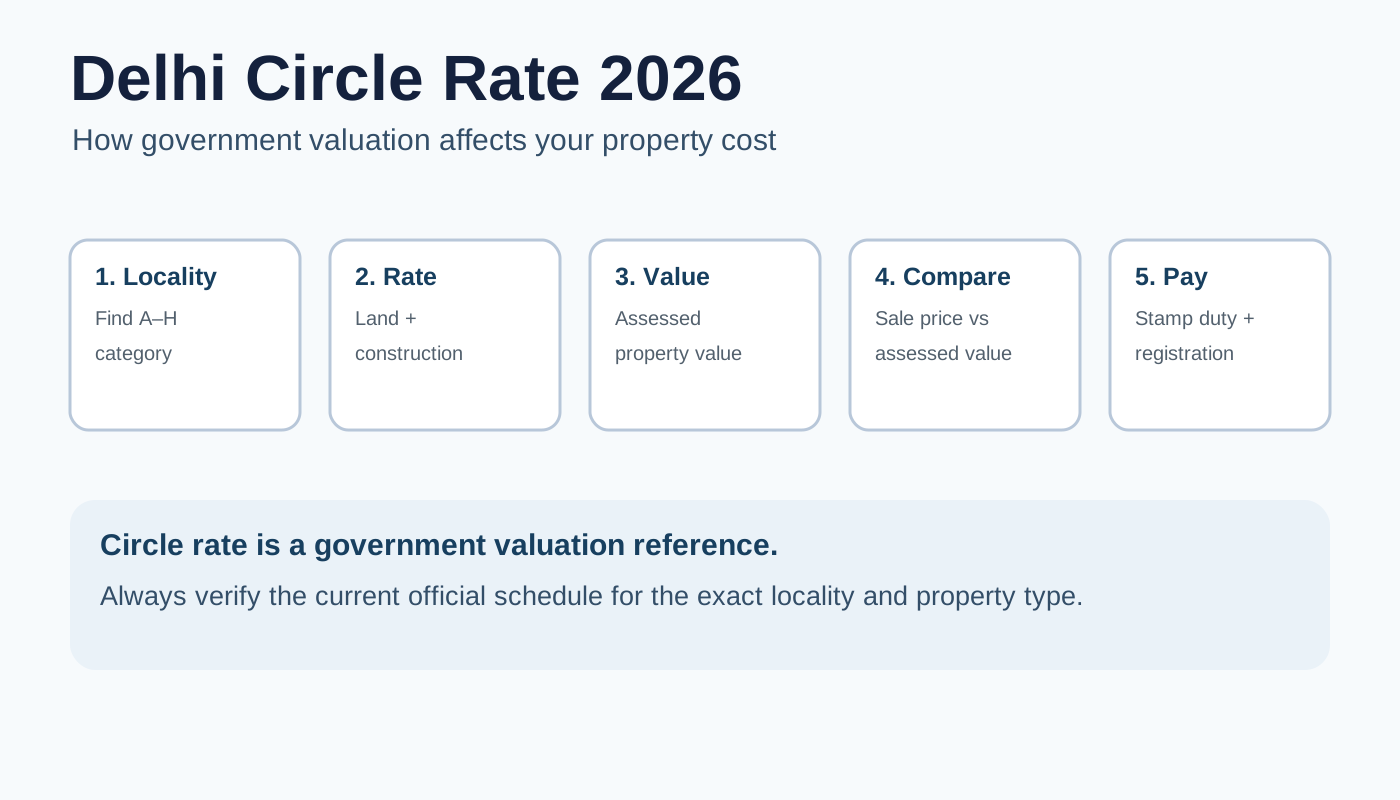
What is the Delhi circle rate in 2026? The Delhi circle rate is the government-notified minimum valuation reference used for registering land and property transactions in Delhi. The Revenue Department publishes category-wise minimum rates for valuation, and the applicable value can depend on the locality category, land use, construction and property type. For sale or conveyance deeds, stamp duty is charged on the consideration amount or applicable circle-rate value, whichever is higher. Delhi Revenue Department.
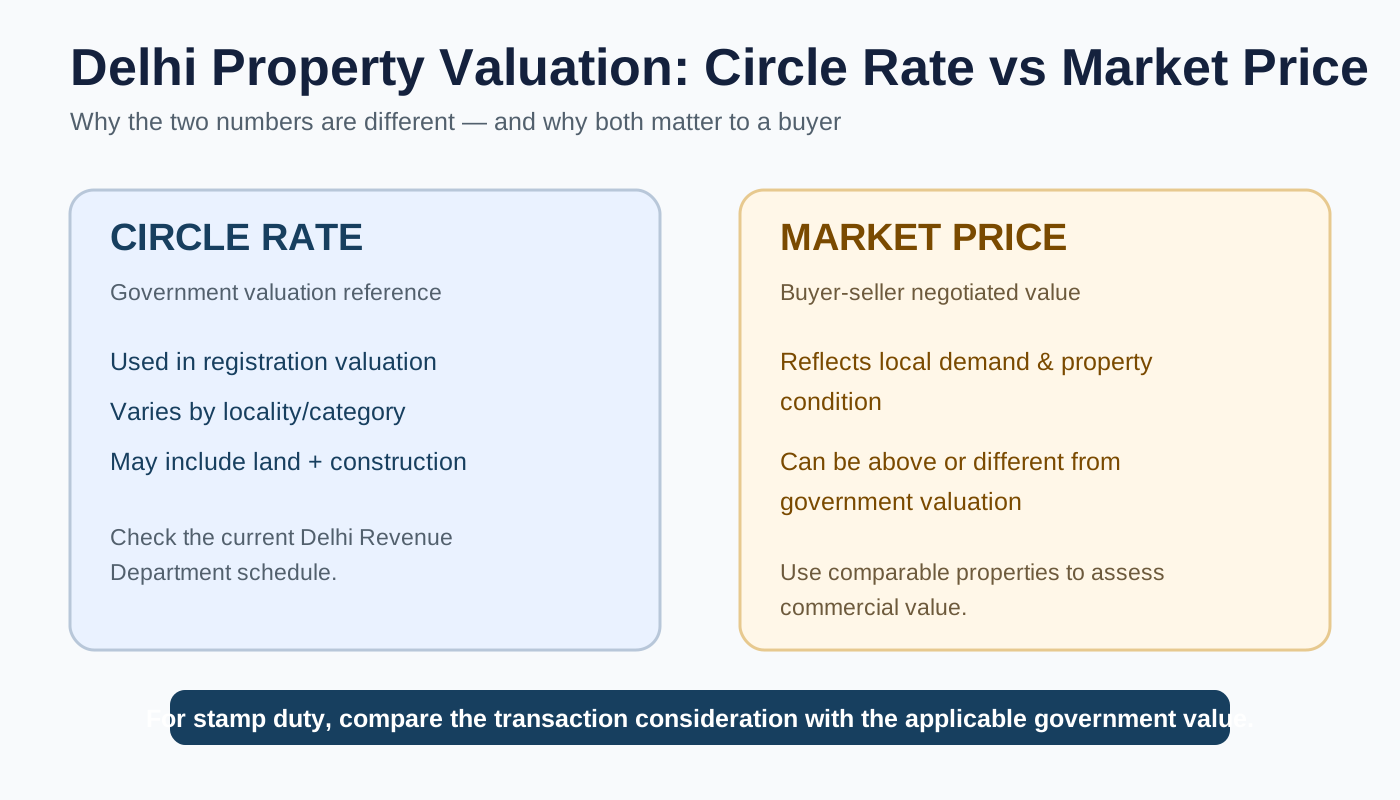
Table of Contents
Why Delhi Circle Rate Matters to a Property Buyer
Many buyers look at only one number: the negotiated sale price.
For registration purposes, that is not always the only number that matters.
The Delhi Revenue Department states that stamp duty for a sale deed or conveyance deed is payable on the consideration amount or the applicable circle-rate value, whichever is higher. It also states that past property-registration details can be searched online without a search fee through the department’s official system. View the official registration information.
This creates an important distinction:
| Term | What it means | Why it matters |
|---|---|---|
| Market price | The price buyers and sellers are negotiating in the market | Helps determine whether the property is commercially attractive |
| Circle rate | Government-notified minimum valuation reference | Can affect the value used for stamp duty and registration |
| Consideration amount | The value recorded for the transaction | Compared with the applicable circle-rate value |
| Registration cost | Government charges linked to registration | Part of the buyer’s total acquisition cost |
What Are the Delhi Circle Rates in 2026?
The Delhi Revenue Department’s notified schedule available on its website lists residential land minimum rates by locality category from Category A to Category H. The same notification also provides construction-rate references. Read the Delhi Revenue Department circle-rate notification.
| Category | Residential land rate (₹/sq. m.) | Residential construction rate (₹/sq. m.) |
|---|---|---|
| A | ₹7,74,000 | ₹21,960 |
| B | ₹2,45,520 | ₹17,400 |
| C | ₹1,59,840 | ₹13,920 |
| D | ₹1,27,680 | ₹11,160 |
| E | ₹70,080 | ₹9,360 |
| F | ₹56,640 | ₹8,220 |
| G | ₹46,200 | ₹6,960 |
| H | ₹23,280 | ₹3,480 |
Important: These figures are official schedule values for the relevant valuation framework, not quotations for what your property will sell for in the open market. The applicable calculation can vary with use, property type, construction, flat category and the specific locality/colony classification. Always verify the exact property against the current government schedule before registration.

Are Delhi Circle Rates and Market Property Prices the Same?
No. Circle rate and market price are different concepts. Circle rate is a government valuation reference, while market price is the price at which the property may actually be negotiated between buyers and sellers.
In some localities, the negotiated market price can be materially above the government minimum valuation. That means a buyer should not use the circle rate as a direct estimate of what the property is worth.
The reverse is also important: finding a property offered below what you expected does not automatically mean the registration value will be based on that lower figure. The applicable government valuation rules still need to be checked.
How Do You Find the Circle Rate for a Delhi Property?
The first step is to identify the property’s exact locality or colony and determine the applicable category and property-use classification.
Delhi Revenue’s e-Sub-Registrar resources specifically provide a category-wise list of colonies for calculation of consideration amount and a category-wise circle-rate schedule for calculation of consideration amount. Open the Delhi e-Sub-Registrar resources.
That matters because searching only for “Delhi circle rate” is not enough. The buyer needs the correct rate for the specific property and locality.
What You Need Before Checking the Rate
- Exact property address
- Colony/locality name
- Property use: residential, commercial or other applicable use
- Property type
- Land area, where relevant
- Built-up/plinth area, where relevant
- Construction details and age, where applicable
- Whether it is a flat, builder floor, independent property or plot
How Is Circle Rate Calculated for a Built Property?
For a built property, the calculation is not always as simple as “circle rate × area.” Delhi’s official material explains that land and construction components are considered, and built-up flats can be governed by separate built-up-rate provisions. The applicable framework can therefore depend on the property type and the relevant rules. Review the official minimum-rate notification.
A simplified conceptual model for a typical land-plus-construction property is:
Assessed value ≈ land component + applicable construction component
The exact calculation should use the government-prescribed method applicable to the specific property.

How Do Delhi Circle Rates Work for Flats?
Flats require special attention because government valuation schedules can use built-up rates or flat-specific categories rather than treating every apartment exactly like an independent plot.
Housing.com’s 2026 Delhi circle-rate reference reports separate minimum built-up rates for DDA/society flats and private builder flats by plinth-area bands, plus different treatment for multi-storey apartments. That article should be used as a secondary reference; the exact registration calculation should still be confirmed against the Delhi government’s current schedule. See Housing.com’s 2026 Delhi circle-rate guide.
| Flat category | What a buyer should verify |
|---|---|
| DDA / society flat | Applicable built-up category, area, tenure and official valuation rule |
| Private builder flat | Plinth/built-up area, applicable private-colony factor and age/valuation rules where relevant |
| Multi-storey apartment | Applicable flat category and government valuation treatment |
| Builder floor | Underlying land/property documentation, floor rights and applicable valuation basis |
Does the Age of the Property Affect Circle-Rate Valuation?
For certain built properties, age-related factors can affect the construction component used in valuation. Delhi’s official rules include age-factor provisions for structures, which is one reason a simple land-rate multiplication can produce the wrong estimate for an older building. See the Delhi Revenue Department’s published valuation provisions.
For a buyer, the practical lesson is simple: do not assume a new construction rate applies unchanged to an older property.
How Do Stamp Duty and Circle Rate Work Together in Delhi?
For a sale deed or conveyance deed, Delhi’s Revenue Department states that stamp duty is charged on the consideration amount or the applicable circle-rate value, whichever is higher. The current published rates are 6% for a male buyer and 4% for a female buyer. Delhi Revenue Department registration guidance.
That means the buyer should compare the two values:
1. Transaction consideration stated for the sale
2. Applicable government valuation for the property
The higher applicable value is the important number for the stamp-duty calculation under the government’s stated rule.
What Are Registration Charges in Delhi?
The Delhi Revenue Department’s current registration guidance states a registration fee of 1% of the total value of the Sale Deed plus ₹100 pasting charge. Stamp duty is separate. Check the official guidance before registration.
So a buyer’s government-registration budget should not be calculated from the purchase price alone. Use:
Total government registration outlay = applicable stamp duty + registration fee + applicable additional charges
Then add your other transaction costs separately, such as legal due diligence, brokerage where applicable, financing expenses, repairs and moving/setup costs.
What Happens If the Sale Price Is Higher Than the Circle Rate?
Suppose a property has:
- Sale consideration: ₹1.50 crore
- Applicable government valuation: ₹1.25 crore
Because the consideration amount is higher, the stamp-duty calculation is based on the higher applicable amount under the Revenue Department’s stated rule.
This is why circle rate should be understood as a minimum valuation reference, not a ceiling on property pricing.
What Happens If the Sale Price Is Lower Than the Applicable Circle-Rate Value?
This is where buyers need to be especially careful.
Suppose:
- Declared consideration: ₹1.10 crore
- Applicable government valuation: ₹1.25 crore
The Revenue Department’s published rule says stamp duty is payable on the higher amount. The buyer therefore needs to understand the government valuation before finalising the registration budget.
Do not rely on a seller’s or intermediary’s verbal estimate of the circle rate.
How Can Buyers Check a Property Registration Value in Delhi?
Delhi Revenue’s official e-Sub-Registrar resources include a category-wise colony list, category-wise circle-rate information, document requirements and registration-process resources. The department also states that past registration details can be searched online without a search fee. Open Delhi’s e-Sub-Registrar information.
A sensible verification sequence is:
- Identify the exact property locality.
- Confirm the locality/category in the government list.
- Confirm the relevant property-use category.
- Check the applicable land or built-up valuation rule.
- Calculate the government valuation using the prescribed framework.
- Compare it with the transaction consideration.
- Estimate stamp duty and registration fee.
- Verify the calculation again before the registration appointment.
What Is the Difference Between Circle Rate, Collector Rate and Market Rate?
In property conversations, buyers may hear different terms such as circle rate, collector rate, ready-reckoner rate or government guidance value. These terms can refer to similar government-set valuation concepts in different jurisdictions.
For Delhi, the Revenue Department uses the language of minimum rates/circle rates for valuation. The market rate is a separate concept based on what properties are actually being offered or transacted for.
What Are the Most Common Circle-Rate Mistakes Delhi Buyers Make?
Using a city-wide number
Delhi does not have one single rate that applies to every property. The locality category and property-specific rules matter.
Confusing circle rate with market price
A government valuation reference is not a market valuation.
Ignoring property type
Plot, flat, builder floor, independent property and commercial property can follow different valuation treatment.
Forgetting construction
For built properties, construction can be part of the applicable government valuation calculation.
Using an old screenshot
Government notifications and registration rules can change. Use the current official Delhi Revenue resources before registration.
Budgeting only for the property price
Stamp duty, registration, legal checks and other acquisition costs must be included in the real purchase budget.
Why the Delhi Circle Rate Can Be Different From What You See in Property Listings
Property portals may display asking prices based on seller expectations, recent market conditions, location premiums and property-specific characteristics.
The government circle-rate framework is designed for valuation and registration purposes.
That means two properties that are both listed at ₹1.50 crore can still have different registration-value calculations if their locality, property type or valuation basis differs.
How Should an Investor Use Circle Rates When Comparing Delhi Properties?
Circle rate should be used as one input, not the entire investment thesis.
For a serious comparison, evaluate:
| Factor | What to compare |
|---|---|
| Market price | Comparable asking and transaction evidence |
| Circle-rate value | Government valuation reference |
| Rental potential | Expected rent and vacancy |
| Total acquisition cost | Price + government + transaction + repair costs |
| Property condition | Age, maintenance and immediate repairs |
| Documentation | Title, authority, dues, approvals |
| Location | Connectivity, demand and liveability |
That approach is more useful than selecting a property simply because its circle rate looks low.
How Does the Delhi Circle Rate Affect a Buyer Planning a Purchase in Rohini?
Rohini is one of Delhi’s established residential markets, but a buyer should still verify the exact colony/category and property type before estimating registration costs. The locality name alone is not a substitute for checking the government category list.
Because Credestate is based in Rohini Sector 29, Delhi, we are using Rohini as one local example while keeping the article applicable across the full Delhi market.
What Should You Ask Before You Register a Delhi Property?
- What is the property’s exact government category?
- What circle-rate schedule applies?
- Is the property a plot, flat, builder floor or independent property?
- What land area or built-up area is being used?
- Does construction value form part of the calculation?
- What is the declared consideration amount?
- Which value is higher for stamp-duty purposes?
- What registration fee applies?
- Have the latest official documents been checked?
Delhi Circle Rate 2026: Practical Buyer Checklist
| Checkpoint | Done? |
|---|---|
| Exact property address confirmed | ☐ |
| Colony/locality identified | ☐ |
| Category A–H confirmed from official list | ☐ |
| Property-use category confirmed | ☐ |
| Applicable land/built-up rate checked | ☐ |
| Construction/age treatment checked where relevant | ☐ |
| Government valuation estimated | ☐ |
| Consideration amount confirmed | ☐ |
| Higher value identified for stamp-duty calculation | ☐ |
| Registration fee calculated | ☐ |
| Official documents rechecked before appointment | ☐ |
How Can You Find Properties for Sale and Rent in Delhi?
Once you understand the registration economics, the next step is to compare actual inventory against your budget, locality, property type and total acquisition cost.
Browse Credestate properties for sale and rent in Delhi to explore residential and commercial listings.
For property enquiries, buyers and sellers can also use the Credestate contact page.
Credestate’s office is located at Ground Floor, Creative Heights, Rohini Sector 29, Delhi – 110039, India.
Frequently Asked Questions About Delhi Circle Rates
What is the circle rate in Delhi in 2026?
Delhi circle rates are government-notified minimum valuation rates used for registration-related property valuation. The Revenue Department publishes category-wise rates for land and also provides construction and property-specific valuation provisions. The exact rate depends on the property and its applicable locality/use category.
What are the eight circle-rate categories in Delhi?
Delhi’s published framework categorises localities into Categories A through H. The residential land reference rates currently published by the Delhi Revenue Department range from ₹7,74,000 per sq. metre for Category A to ₹23,280 per sq. metre for Category H.
Is circle rate the same as market value?
No. Circle rate is a government valuation reference for registration purposes, while market value reflects the price buyers and sellers may actually negotiate in the market.
How is stamp duty calculated using circle rate in Delhi?
For sale or conveyance deeds, Delhi’s Revenue Department states that stamp duty is payable on the consideration amount or the applicable circle-rate value, whichever is higher. The published rate is 6% for a male buyer and 4% for a female buyer.
Does circle rate apply to flats in Delhi?
Yes, but the valuation treatment for flats can differ from a simple land-rate calculation. Built-up flat rates and other prescribed factors may apply depending on flat size, building type and the applicable government framework.
Can circle rate be lower than the market price?
Yes. A government minimum valuation reference can be below the actual market price negotiated for a property. That is one reason buyers should use circle rate for registration planning, not as a standalone market valuation.
Where can I check the Delhi circle-rate category for my property?
The Delhi Revenue Department’s e-Sub-Registrar resources include a category-wise list of colonies and a category-wise circle-rate schedule. Buyers should use those official resources for the exact property locality.
Final Takeaway
Delhi circle rate 2026 is not simply a number you search on Google and copy into a property calculator.
The correct process is:
Locality → Category → Property type → Applicable valuation rule → Government value → Compare with consideration → Stamp duty → Registration fee
That sequence is what turns a headline circle-rate figure into a meaningful registration estimate.
For broader market context, read Credestate’s Property Rates in Delhi 2026 guide. Before paying token money, also use our Delhi Property Buying Checklist.
Disclaimer: This article is general informational content and is not legal, tax, valuation or financial advice. Government rates and registration rules should be checked against the latest Delhi Revenue Department notification and the specific property before a transaction is registered.


Join The Discussion