
Last updated: September 25, 2026
What are property rates in Delhi in 2026? Delhi does not have one single property rate. Prices vary significantly by locality, property type, size, construction age, connectivity, amenities and documentation. Current market data shows meaningful differences between localities such as Vasant Kunj, Dwarka, Rohini, Chhattarpur, Burari and Central Delhi.
What Are Property Rates in Delhi in 2026?
Current Housing.com data reports an average asking price of approximately ₹14,840 per sq. ft. for New Delhi, while also showing large locality-level differences. The same data currently shows approximately ₹21,658 per sq. ft. for Vasant Kunj, ₹16,179 for Dwarka Sector 6, ₹6,298 for Chhattarpur and ₹5,487 for Burari. These are portal-reported averages, not government valuations or guaranteed transaction prices.
See current Delhi locality price data on Housing.com.
| Locality | Indicative portal average | What to compare |
|---|---|---|
| Vasant Kunj | ₹21,658/sq. ft. | Property type, age, floor, amenities |
| Dwarka Sector 6 | ₹16,179/sq. ft. | Sector, apartment type, condition |
| Dwarka Sector 4 | ₹16,075/sq. ft. | Building, floor, parking |
| Chhattarpur | ₹6,298/sq. ft. | Plot, construction, road access |
| Burari | ₹5,487/sq. ft. | Micro-location and property type |
Market figures are indicative and can change. A property should always be compared with similar properties in the same micro-market.
How Do Property Rates in Delhi Differ by Area?
North and North-West Delhi
North and North-West Delhi include Rohini, Pitampura, Shalimar Bagh, Model Town, Burari and nearby markets. Buyers will find apartments, DDA properties, builder floors, independent houses and plots. Sector, metro access, road width, property age and construction quality can create significant price differences within the same locality.
West Delhi
West Delhi includes Janakpuri, Rajouri Garden, Punjabi Bagh, Patel Nagar, Vikaspuri, Uttam Nagar and neighbouring areas. Connectivity and access to established markets are important considerations, but property type remains one of the biggest pricing variables.
South Delhi
South Delhi contains several premium and established residential markets such as Vasant Kunj, Saket, Greater Kailash, Defence Colony, Hauz Khas and Vasant Vihar. Current portal data illustrates the higher asking-price bands visible in some of these markets.
East Delhi
Mayur Vihar, Preet Vihar, Laxmi Nagar, IP Extension, Anand Vihar, Krishna Nagar and Shahdara form important East Delhi markets. The right comparison should consider the exact block, property age, connectivity and whether the asset is residential or commercial.
South-West Delhi
Dwarka, Palam, Mahipalpur and Najafgarh represent different parts of the South-West Delhi market. Dwarka is particularly sector-driven, with current market data showing different average prices across individual sectors.
Central Delhi and New Delhi
Central Delhi markets such as Karol Bagh, Rajinder Nagar and adjoining areas can command very different prices from outer Delhi. Current Housing.com data reports approximately ₹20,837 per sq. ft. for Delhi Central and approximately ₹25,492 per sq. ft. for Karol Bagh in its current locality data.
How Should You Compare Property Rates in Delhi by Locality?
There is no universally correct locality for every buyer. A better approach is to build a shortlist based on budget, commute, property type and intended use.
| Delhi market | Examples to research | Key comparison factors |
|---|---|---|
| North / North-West | Rohini, Pitampura, Model Town, Burari | Metro, sector, property age |
| West Delhi | Janakpuri, Punjabi Bagh, Rajouri Garden, Vikaspuri | Connectivity, market access, property type |
| South Delhi | Vasant Kunj, Saket, Greater Kailash, Defence Colony | Micro-location, plot/building, amenities |
| East Delhi | Mayur Vihar, Preet Vihar, IP Extension, Laxmi Nagar | Transit, roads, age, use |
| South-West Delhi | Dwarka, Palam, Mahipalpur, Najafgarh | Sector, connectivity, apartment stock |
| Central Delhi | Karol Bagh, Rajinder Nagar, Patel Nagar | Central access, property type, age |
How Do Property Rates in Delhi Vary for Flats?
There is no single Delhi flat price. The useful comparison is same locality + same property type + similar area + similar age + similar condition.
1 BHK Flats in Delhi
One-bedroom homes can suit single occupants, couples and some rental investors. Pricing depends heavily on the locality and whether the property is an apartment, builder floor or another form of housing.
2 BHK Flats in Delhi
Two-bedroom homes are widely searched by families and investors. Compare usable area, floor, parking, building age, maintenance and exact location rather than headline price alone.
3 BHK Flats in Delhi
Three-bedroom properties typically move into a different budget segment and can vary sharply between localities. Parking, lift, floor area, renovation and surrounding infrastructure matter.
Builder Floors in Delhi
Builder floors deserve separate analysis because land share, floor ownership, parking, construction quality and documentation can materially affect value.
What Are Property Rates in Delhi for Land and Plots?
Land prices can vary even more dramatically than apartment prices because plot size, road width, land use, colony characteristics, construction and documentation all affect value.
Before evaluating a plot, check:
- Ownership and title
- Plot dimensions and boundaries
- Applicable land-use requirements
- Existing construction and approvals
- Property tax and other dues
- Encumbrances and lender claims
- Applicable circle-rate and registration requirements
What Are Rental Rates in Delhi?
Rental rates in Delhi depend on locality, property type, furnishing, age, connectivity and proximity to employment or education centres. A furnished apartment near a major metro corridor can have a very different rent from an older unfurnished property elsewhere.
For a basic investment comparison, buyers can calculate:
Indicative gross rental yield = Annual rent ÷ Total property cost × 100
This is only a starting calculation. Vacancy, maintenance, taxes, financing costs and other expenses can materially change the actual return.
What Factors Affect Property Rates in Delhi?
Location and Connectivity
Access to metro stations, major roads, employment hubs, markets and public services can affect demand and pricing.
Property Type
A 2 BHK apartment, 3 BHK builder floor, independent house and residential plot are different products. They should not share the same benchmark.
Property Age and Condition
Two properties in the same locality can have very different prices because of construction age, renovation quality, floor, lift, parking and maintenance.
Local Infrastructure
Schools, hospitals, markets, parks, metro access and road connectivity can affect the desirability of a micro-market.
Supply and Demand
JLL’s Q2 2026 Delhi NCR residential report noted that sales moderated year-over-year while demand remained active in several growth markets. This is one reason buyers should look at both available inventory and buyer demand rather than relying on a single headline number.
Read JLL’s Q2 2026 Delhi NCR residential market report.
What Is the Circle Rate in Delhi?
Circle rate is an important reference in Delhi property transactions because it can affect the value used for stamp-duty and registration calculations. The Delhi Revenue Department currently states that for sale/conveyance deeds, stamp duty is calculated at 6% for a male buyer and 4% for a female buyer on the consideration amount or applicable circle-rate value, whichever is higher.
The Delhi Revenue Department also currently lists a 1% registration fee plus ₹100 pasting fee for the relevant property registration process.
Check the Delhi Revenue Department’s current property-registration guidance.
Important: Government rules and applicable rates can change. Buyers should verify current charges with the relevant Delhi government authority before registering a transaction.
How Much Are Stamp Duty and Registration Charges in Delhi?
For sale/conveyance deeds, the Delhi Revenue Department currently lists 6% stamp duty for male buyers and 4% for female buyers, calculated on the consideration amount or applicable circle-rate value, whichever is higher. Registration fee is currently listed at 1% plus ₹100 pasting charges.
Total acquisition cost should therefore be considered as:
Property price + stamp duty + registration + legal/due-diligence costs + applicable financing and transaction expenses.
What Should You Check Before Buying Property in Delhi?
Price is only one part of a property purchase. Buyers should investigate the specific property and ownership trail before making a substantial financial commitment.
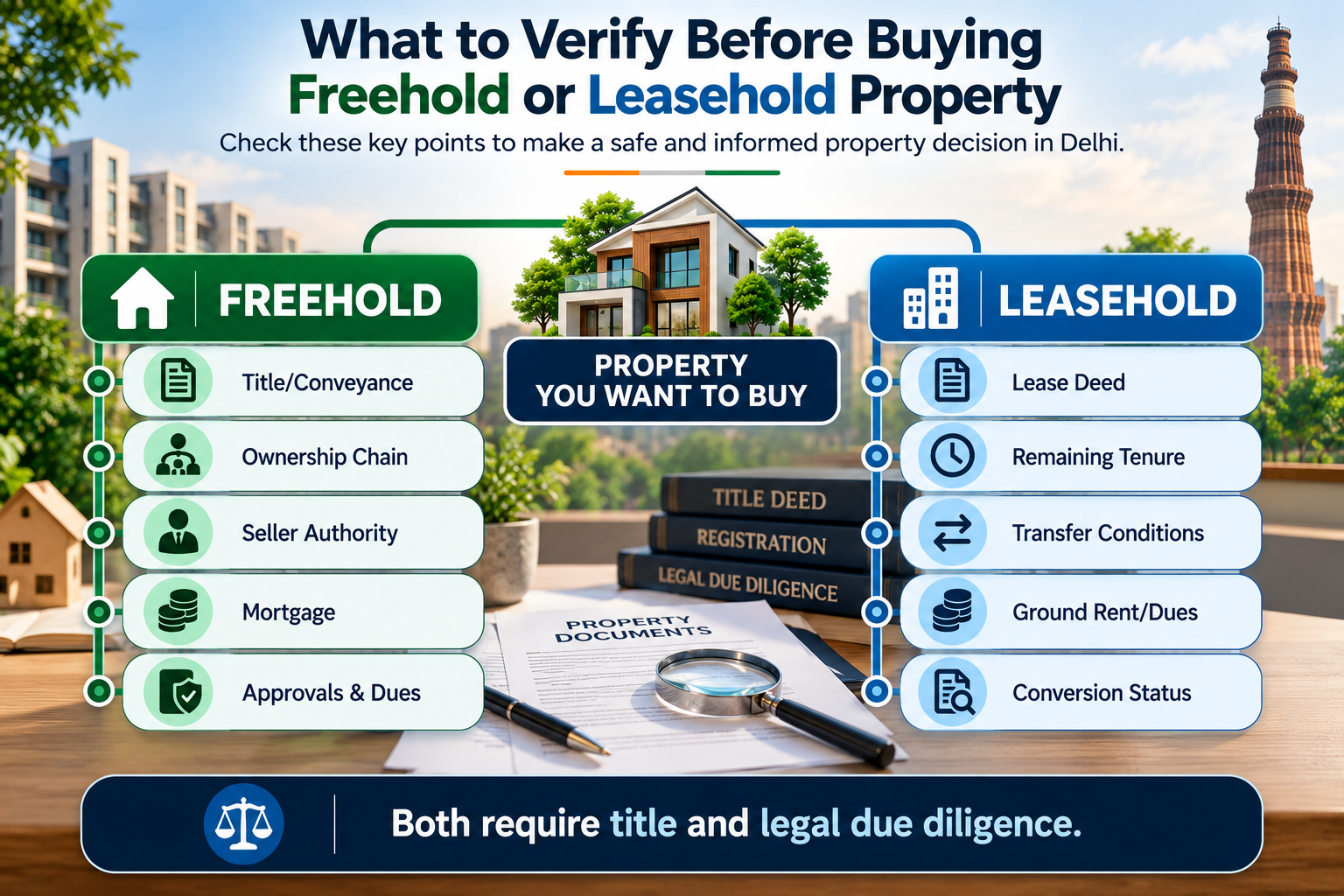
- Sale Deed or applicable Conveyance Deed
- Previous ownership/title documents
- Seller identity and authority to sell
- Registration records
- Mortgage, encumbrance and outstanding dues
- Mutation and relevant property records
- Sanctioned building plan and applicable approvals
- Completion/occupancy documentation where applicable
- DDA documents where applicable
- RERA information where applicable
- Property-tax and utility records
- Physical property inspection
For a detailed Delhi-specific checklist, read Documents to Check Before Buying Property in Delhi in 2026.
How Can You Compare Property Rates in Delhi Across Localities?
A useful comparison should use the same variables for every property:
Locality → Sector/Block → Property Type → Area → Age → Floor → Parking → Condition → Documentation → Asking Price
For example, comparing a renovated 3 BHK builder floor in Greater Kailash with an older 3 BHK apartment in Rohini is not a meaningful like-for-like comparison.
How Can You Find Properties for Sale and Rent in Delhi?
Start with your preferred localities, property type, size and budget, then compare available options using the same criteria.
Browse Credestate properties for sale and rent in Delhi to explore current residential and commercial listings.
For property enquiries, buyers and sellers can also use the Credestate contact page.
Credestate’s Delhi office is located at Ground Floor, Creative Heights, Rohini Sector 29, Delhi – 110039, India.
Frequently Asked Questions About Property Rates in Delhi
What are the property rates in Delhi in 2026?
Property rates in Delhi vary widely by locality and property type. Current 2026 portal data shows substantial differences between areas such as Vasant Kunj, Dwarka, Chhattarpur, Burari and Central Delhi. Portal averages are useful for market research, but the actual value of an individual property depends on its exact location, size, condition and documentation.
Which areas of Delhi have higher property prices?
Premium and established markets in parts of South Delhi and Central Delhi can show higher asking prices than several North, North-West and peripheral markets. However, there is no uniform price even within a locality, so buyers should compare similar properties at the sector or block level.
How much does a flat cost in Delhi?
The cost of a flat depends on locality, configuration, area, building age, floor, parking, amenities and construction quality. The most useful benchmark is a comparison with similar properties in the same micro-market.
What is the stamp duty on property in Delhi?
The Delhi Revenue Department currently lists stamp duty at 6% for male buyers and 4% for female buyers on sale/conveyance deeds, based on the consideration amount or applicable circle-rate value, whichever is higher. Buyers should verify current charges before registration.
What is the registration fee for property in Delhi?
The Delhi Revenue Department currently lists a 1% registration fee plus ₹100 pasting charges for the relevant property-registration process. Always confirm the current applicable charges before completing a transaction.
Is Rohini one of the areas buyers should research in Delhi?
Rohini is an established Delhi residential market with sector-based development and a mix of apartments, DDA properties, builder floors and other housing options. Buyers should compare individual sectors and properties based on budget, connectivity, condition, documentation and intended use.
What documents should I check before buying property in Delhi?
Buyers should investigate ownership and title documents, the ownership chain, seller authority, relevant approvals, tax and utility records, outstanding dues and encumbrances. The exact checklist depends on the property type and ownership history.
Delhi Property Buying Checklist
- Confirm the exact property address.
- Compare the asking price with similar nearby properties.
- Check ownership and title documents.
- Review previous ownership records.
- Investigate outstanding dues and encumbrances.
- Inspect the property physically.
- Verify construction and applicable approvals.
- Calculate stamp duty and registration costs.
- Estimate financing and other acquisition expenses.
- Obtain appropriate legal due diligence before committing substantial funds.
Final Thoughts on Property Rates in Delhi
The most important thing to understand about property rates in Delhi in 2026 is that there is no single Delhi-wide price.
The market changes from locality to locality and from property to property. A useful comparison combines locality, sector, property type, size, condition, connectivity, documentation and total acquisition cost rather than relying on one headline number.
Whether you are researching Rohini, Dwarka, South Delhi, West Delhi, East Delhi, Central Delhi or another part of Delhi, compare like-for-like properties and verify the facts before making a purchase decision.
Ready to compare available properties? Explore Credestate’s Delhi property listings or contact Credestate for property assistance.
Disclaimer: Property prices shown by market portals are indicative and can change by property, micro-location, condition, configuration and transaction terms. Government charges and registration requirements should be verified with the relevant Delhi authority before completing a transaction. This article is general informational content and is not legal, tax or financial advice.

Join The Discussion